


In this article
If your first language is Russian, Ukrainian, Mandarin, Japanese, Korean, or Hindi, articles are probably the single most frustrating part of English. None of these languages use a, an, or the the way English does. So when you write English, there is no habit to fall back on — you are making a decision your native language never asked you to make. The result is predictable: you drop articles where English needs one, or you add one where English wants none.
This is the classic article-less-L1 problem, and it is not a sign that your English is weak. It is a structural gap. The good news: articles follow a system. Once you have a decision sequence to run for each noun, the guesswork mostly disappears. This guide gives you that sequence, a reference table, and a practice list with answers.
Why your language did not prepare you for this
English uses articles to signal whether a noun is specific and already known to the reader, or new and one of many, or general. Your first language carries that same information — it just does not use little words in front of the noun to do it.
- Russian and Ukrainian have no articles. Word order and context tell the listener whether you mean a specific thing or any thing.
- Mandarin uses word order, demonstratives ("this/that"), and measure words instead of articles.
- Japanese and Korean mark topic and definiteness through particles and context, not through a/an/the.
- Hindi has no direct equivalent of "a" or "the"; "one" (ek) sometimes does the work of "a," but there is no everyday article system.
So the meaning is in your head — you just have to learn where English forces you to make it explicit. That is the whole task.
First, the easy one: a vs an (sound, not spelling)
Many learners memorize "use an before vowels: a, e, i, o, u." That rule is almost right, and the small error it causes is very common. The real rule is about sound, not the letter.
- Use an before a word that starts with a vowel sound.
- Use a before a word that starts with a consonant sound.
Say the word out loud and listen to the very first sound:
Wrong: a hour, a honest mistake, an university, an European country
Right: an hour, an honest mistake, a university, a European country
"Hour" and "honest" begin with a silent h, so the first sound is a vowel — you need an. "University" and "European" begin with a "yoo" sound, which is a consonant sound — you need a. The spelling lies; the sound tells the truth. The same goes for "a one-time offer" (it sounds like "wun") and "an MBA" (the letter M is read "em," a vowel sound).
The three choices: a/an, the, or nothing
For every countable singular noun you write, English gives you three options. Here is what each one means.
1. a / an — indefinite (new and non-specific)
Use a or an when the noun is countable, singular, and either first-mentioned or one of many — the reader does not yet know which one you mean.
Right: I bought a laptop yesterday. (one of many laptops; the reader does not know which)
Right: She is a doctor. (one member of the category "doctors")
Right: Can you pass me a pen? (any pen; it does not matter which)
2. the — definite (specific and shared)
Use the when the noun is specific and already known to both you and the reader. They can identify exactly which one you mean — because you mentioned it before, because it is the only one, or because the context makes it obvious.
Right: I bought a laptop yesterday. The laptop is already broken. (second mention — now we both know which one)
Right: Please close the door. (the obvious door, the one in this room)
Right: The sun is bright today. (there is only one)
3. no article — zero article (general or uncountable)
Use no article for general statements, and you have three main cases: plural countable nouns talked about in general, uncountable nouns talked about in general, and most proper nouns.
Wrong: The cats are independent animals. (this means a specific group of cats)
Right: Cats are independent animals. (cats in general)
Wrong: The information you sent was the water for my plants. The water is essential for life.
Right: Water is essential for life. (water in general — uncountable, general = no article)
Right: I live in Japan and work for Google. (most proper nouns take no article)
The decision sequence (run this for every noun)
When you are unsure, ask these questions in order and stop at the first "yes."
- Is it specific and already known to the reader? (mentioned before, the only one, or obvious from context) → use the.
- Is it the first mention, countable, and singular? (one of many, not yet identified) → use a / an (pick by sound).
- Is it a generic plural, an uncountable noun, or a proper noun? (a general statement) → use no article.
Walk one through it: "I need ___ advice about ___ contract you sent." "Advice" is uncountable and general → no article. "Contract" is specific and known (the one you sent) → the. Result: "I need advice about the contract you sent."
Quick reference table
| Situation | Use | Example |
|---|---|---|
| First mention, countable singular | a / an | I saw a dog in the park. |
| Second mention / already known | the | The dog was friendly. |
| Only one of its kind | the | The moon, the internet, the CEO of this company |
| Specific by context | the | Pass me the salt. (the one on the table) |
| Plural, general statement | no article | Dogs are loyal. |
| Uncountable, general statement | no article | Honesty matters. Money is tight. |
| Most proper nouns (people, cities, most countries) | no article | I met Maria in Berlin. |
| Superlatives and ordinals | the | the best option, the first time |
Common traps for article-less speakers
The three-step rule covers most cases. These are the corners where it gets slippery — and where speakers of article-less languages most often slip.
Abstract and uncountable nouns
Abstract nouns (advice, information, knowledge, research, progress, equipment, software) are usually uncountable in English. When you talk about them in general, use no article — and never add an s to make a plural.
Wrong: She gave me a good advice. He has many informations.
Right: She gave me good advice. He has a lot of information.
Institutions: "go to school" vs "go to the school"
This is the trap almost everyone hits. With certain institutions, English drops the article when you mean the role or purpose, and keeps it when you mean the specific building.
Right: My son goes to school. (he is a student — the role)
Right: I drove to the school to pick him up. (the physical building)
The same pattern: "She is in hospital" (a patient) vs "I parked at the hospital" (the building); "He is at university" (studying) vs "the university announced new fees" (the institution as an entity). British English drops more articles here than American English, but the role-vs-building logic holds in both.
Fixed expressions
Some phrases just have to be memorized — the article is baked in and the rule will not explain it.
No article: at home, at night, by car, on foot, in bed, go to work, have breakfast
With "the": in the morning, in the afternoon, on the whole, in the end, the same
When you meet one of these, learn it as a chunk. Do not try to derive it.
Practice list (answers below)
Fill the blank with a, an, the, or — (no article).
- I work as ___ engineer at ___ startup.
- Can you turn off ___ light? It is too bright.
- ___ honesty is important in ___ relationships.
- We waited for ___ hour, but ___ bus never came.
- She is studying at ___ university in ___ London.
- I read ___ interesting book last week. ___ book was about ___ history.
- ___ water in this region is not safe to drink.
- He gave me ___ useful advice about ___ job I applied for.
Answers:
- an engineer / a startup (first mention, countable singular; "engineer" starts with a vowel sound)
- the light (specific — the one in this room)
- — honesty / — relationships (both general: uncountable and generic plural)
- an hour / the bus ("hour" = vowel sound; "the bus" = the specific one you were waiting for)
- a university / — London ("university" = "yoo" consonant sound → "a"; cities take no article)
- an interesting book / The book / — history (first mention → "an"; second mention → "the"; "history" general → no article)
- The water (specific — the water in this region, identified by context)
- — advice / the job ("advice" uncountable general → no article; "the job" you specifically applied for)
If you got most of these by running the three-step sequence rather than by feel, the system is working. Speed comes with repetition.
A faster way to find your own article mistakes
Reading the rule is one thing; catching your own dropped the in a 600-word email is another — because the article you forgot is invisible to you. You did not write it, so there is nothing to notice. This is exactly why article errors survive even careful proofreading by speakers of article-less languages.
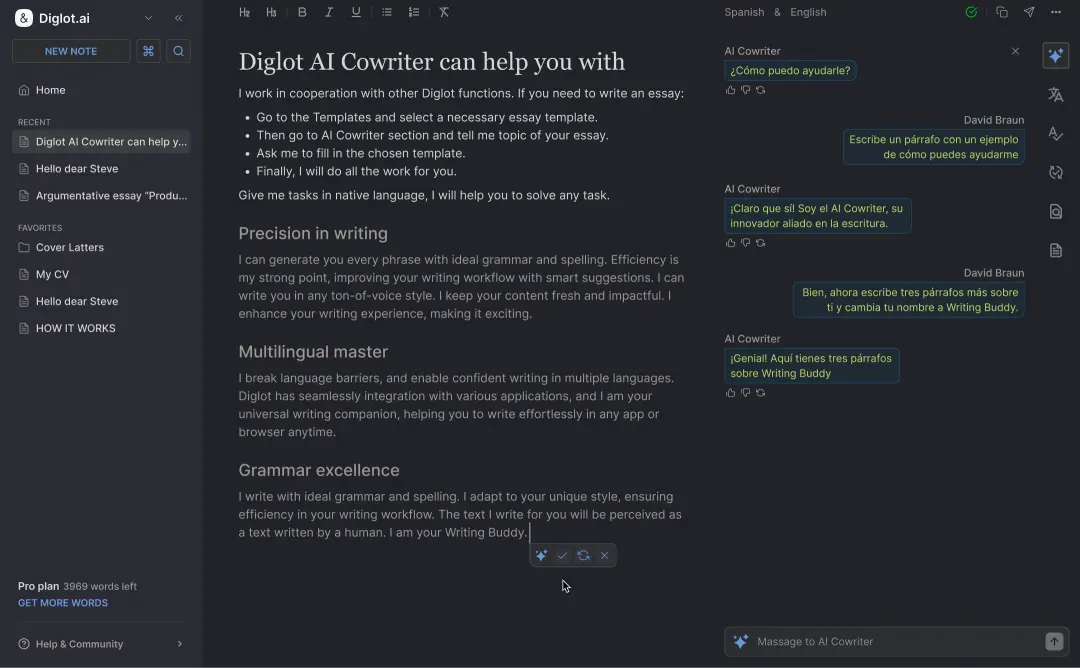
Two things help. First, find out which interference patterns your specific first language pushes you toward — our free Native Language Detector reads a writing sample and shows the article and grammar habits that tend to come from your L1. Second, run your draft through a checker that is tuned for these patterns: the Diglot grammar checker flags missing articles, a/an mismatches, and the dropped into general statements, and it explains why — so you learn the rule, not just the fix.
Articles are one piece of a bigger picture. If your English is correct but still feels off to native readers, see why your English sounds translated. And for the other small marks that carry meaning differently across languages, read about punctuation differences for non-native writers.
The dropped article is also just one of the habits your first language carries into English. For the full set of patterns specific to your language — and the other errors that travel with the missing a or the — see the guides for Chinese, Korean, Japanese, Russian, Arabic, Hindi, and Vietnamese speakers, all article-less languages where the missing article is only the start.
You already know what you mean — your first language has always carried that meaning. Articles are just the place English asks you to say it out loud. Learn the three-step sequence, practice it on real sentences, and let a tool catch the ones you miss while the habit forms. Try the Diglot grammar checker on your next draft and watch where the articles go.