


In this article
The errors are systematic, not careless
If you are an Arabic speaker writing in English, your mistakes follow a pattern set by your first language. Arabic is a Semitic, root-and-pattern language that is structurally far from English. It has one definite article and no indefinite article, no present-tense "to be", a verb-first tendency, and a script with no capital letters. English does almost the opposite of each.
That contrast is what makes the common English mistakes Arabic speakers make so predictable. Research on Arab learners consistently finds that first-language transfer drives most written errors, which is good news: a predictable problem is a fixable one. Below are the ten patterns that cause the most trouble, each with the Arabic habit behind it and a fast fix. Those fingerprints are consistent enough that a free tool can often detect your native language from your writing alone.
1. Missing articles and overused "the"
Arabic has no indefinite article, and its definite article attaches more widely than English "the". So writers drop a/an and over-apply "the".
Off: "I bought car. I am teacher."
Native: "I bought a car. I am a teacher."
Off: "The life is beautiful."
Native: "Life is beautiful."
Every singular countable noun needs a, an, or the. But general nouns like "life" and "people in general" take no article. The full system is in the guide to a, an, and the for article-less languages.
2. The missing "be" verb
Arabic present-tense sentences have no verb "to be". "He happy" is complete and correct in Arabic. English needs "is".
Off: "He happy. They in the office. She a doctor."
Native: "He is happy. They are in the office. She is a doctor."
Read each present-tense sentence and check it has a verb. If it only has an adjective or a place, insert is, am, or are.
3. Subject-verb agreement and word order
Arabic verbal sentences often put the verb first, and its agreement rules differ from English. So agreement slips and verb-first order appear.
Off: "The students is studying. Played the children in the park."
Native: "The students are studying. The children played in the park."
English wants subject, then verb, then object, with the verb matching the subject.
4. Adjective placement
Arabic places adjectives after the noun. English puts them before.
Off: "I have a pen red and a car fast."
Native: "I have a red pen and a fast car."
5. Singular, plural, and the Arabic dual
Arabic has a dual form for exactly two, plus irregular plurals. So English number marking gets mishandled, both dropped and over-applied.
Off: "I read two book and got many informations."
Native: "I read two books and got a lot of information."
Add -s for more than one. Keep information, advice, and news singular.
6. Prepositions
Arabic pairs verbs with different prepositions, so they get translated literally.
Off: "I arrive to the airport in Monday."
Native: "I arrive at the airport on Monday."
Learn the verb and preposition together: arrive at, depend on, consist of.
7. Run-on sentences and the repeated "and"
This one is the clearest tell. The Arabic particle wa ("and") connects almost every clause. Moved into English, it builds long, additive run-ons.
Off: "I woke up and I ate and I went to work and it was raining and I was late."
Native: "I woke up and ate, then went to work. It was raining, so I was late."
If a sentence has three or more "and"s, split it and vary the connectors: then, because, so, while. The free run-on sentence checker finds these in a draft and marks where each one should have been split. For more on the pattern itself, see sentence fragments and run-ons in English.
8. Tense and aspect
Arabic has a two-way perfective and imperfective system with no direct present-perfect equivalent. So the present perfect gets replaced by the simple past or present.
Off: "I lived in London for five years." (and still do)
Native: "I have lived in London for five years."
Use the present perfect for something that started in the past and continues now.
9. The p/b and v/f sounds (that leak into spelling)
Arabic has no /p/ or /v/, so writers substitute /b/ and /f/ — and the swap can show up in spelling. (See an authoritative summary at Speak Up London.)
Off: "Ben and baber. Fery good facation."
Native: "Pen and paper. Very good vacation."
For /p/, add a strong puff of air. For /v/, put your top teeth on your lower lip.
10. Capitalization and spelling
Arabic script has no capital letters, so writers under-capitalize. Spelling is also nearly phonemic in Arabic, which clashes with English's silent letters.
Off: "i live in cairo and i am egyptian."
Native: "I live in Cairo and I am Egyptian."
Capitalize sentence starts, "I", names, cities, and nationalities.
A quick self-check before you send
| Check | What to look for |
|---|---|
| Articles | Does each singular countable noun have a, an, or the? |
| "Be" verb | Every present sentence needs a verb: "He [is] happy". |
| "And" count | Three or more "and"s? Split the sentence. |
| Adjectives | Before the noun: "a red pen", never "a pen red". |
| Agreement | Plural subject takes a plural verb: students are. |
| Capitals | Sentence starts, I, names, cities, nationalities. |
| Sounds | p not b (pen), v not f (very). |
How Diglot helps Arabic speakers
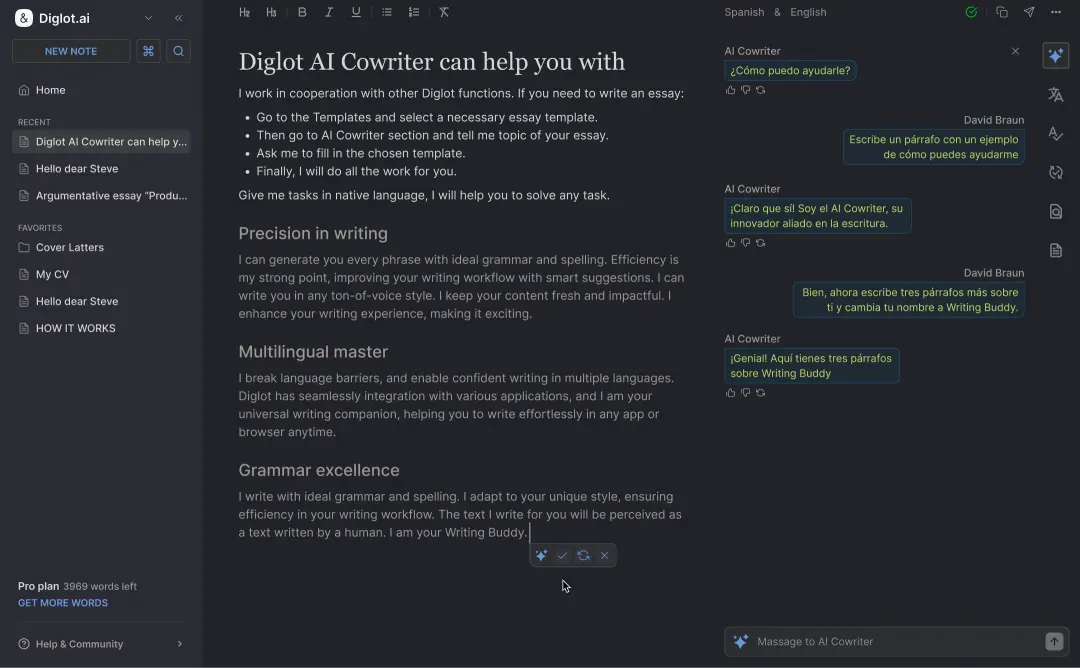
Diglot is built for the bilingual workflow, where you think in Arabic and write in English. That is exactly where missing articles, the dropped "be", and run-on "and" sentences come from. Instead of only flagging a mistake, it shows the natural version and the reason, so you learn the pattern.
- Catch L1-transfer errors in context. The grammar checker for Arabic speakers is tuned for the article, copula, agreement, and run-on slips above.
- Rewrite translated-sounding sentences. The Arabic-speaker paraphrasing tool turns word-for-word translations into natural English while keeping your meaning.
- Learn, do not just accept. Each suggestion explains the fix. See why translated text reads off in why your English sounds translated.
- One workspace for the whole task. Explore the full ESL writing tool built for non-native writers.
Your English is already good enough to communicate. Closing this short list of grammar gaps is what makes it read as fluent. Add the article, restore the "be", break up the "and", and your writing stops sounding translated and starts sounding like you.
Try the grammar checker for Arabic speakers