


In this article
Different grammar, predictable errors
If you are a Chinese speaker writing English, your mistakes are not random. Mandarin has no articles, no plural endings on nouns, and verbs that never change form. It marks whether an action is finished, not when it happened. It builds sentences around a topic instead of a subject, and in speech it does not even distinguish "he" from "she". English does the opposite on every point.
Each mismatch produces a specific, repeatable error, a textbook case of L1 interference. That is good news: a short, known list is fixable. Below are the nine patterns that cause the most trouble, each with the Mandarin habit behind it and a fast fix. These patterns are consistent enough that a free tool can often guess which L1 your English reveals from a single paragraph.
1. Missing or misused articles (a, an, the)
Mandarin has no article system. Whether a noun is definite comes from word order, context, or demonstratives like 这 (zhè, this) and 那 (nà, that). So in English, articles get dropped or inserted by feel, and this is the most persistent error in Chinese-English writing.
Off: "I bought book from store near my office."
Native: "I bought a book from the store near my office."
A working habit: the first time you mention a countable thing, it takes "a" or "an"; once you have named it, it takes "the". Scan every singular countable noun in your draft; most of them need something in front.
2. Missing plural -s
Chinese nouns never change for number. 两本书 (liǎng běn shū) is literally "two [measure word] book": the number does all the work and the noun stays bare. Carried into English, the -s falls off.
Off: "I read two book last month and wrote three report."
Native: "I read two books last month and wrote three reports."
The rule is strict in English: if there is more than one, mark it. The only plural-like ending in Mandarin, 们 (men), applies to people and pronouns, so it will not remind you about books or reports.
3. Verb tense — "Yesterday I go"
Chinese verbs mark aspect, not tense. 了 (le) says an action is complete, and 过 (guo) says you have experienced it before; the actual time comes from adverbs like 昨天 (zuótiān, yesterday) or 明年 (míngnián, next year). The verb itself never changes. Transfer that into English and you get a time word at the front with a present-tense verb behind it.
Off: "Yesterday I go to the library and finish my essay."
Native: "Yesterday I went to the library and finished my essay."
The fix is a habit shift: in English, the time must live on the verb, not just at the front of the sentence. When you write a time expression, immediately check that every verb after it agrees with it.
4. Mixing up "he" and "she"
他 (he), 她 (she), and 它 (it) are all pronounced tā. Spoken Mandarin never forces a gender choice, so the instant-selection habit English requires was never trained. The result is one of the most recognizable signatures of Chinese-English: pronouns that flip mid-paragraph.
Off: "My mother is a doctor. He works at the city hospital."
Native: "My mother is a doctor. She works at the city hospital."
This is not a knowledge gap; you know the rule. It is a speed slip. The fix is mechanical: after drafting, do one pass that only checks pronouns against the people they refer to.
5. "Open the light" and other word-for-word phrases
The Mandarin verb 开 (kāi) covers open, turn on, start, and drive, and 关 (guān) covers both close and turn off. Translate the collocation directly and you get a calque — a phrase copied word for word that no native speaker uses. These are the most common ones:
| Chinese | Word-for-word | Natural English |
|---|---|---|
| 开灯 (kāi dēng) | open the light | turn on the light |
| 关电脑 (guān diànnǎo) | close the computer | turn off the computer |
| 吃药 (chī yào) | eat medicine | take medicine |
| 大雨 (dà yǔ) | big rain | heavy rain |
| 学知识 (xué zhīshi) | learn knowledge | gain knowledge / learn |
| 我很喜欢 (wǒ hěn xǐhuan) | I very like it | I really like it |
The pattern behind all of them is the same: the word pair is correct in Chinese, but English pairs its words differently. When a phrase feels like a direct translation, it probably is one: check the collocation, not the dictionary. This "translated" feeling has its own fixes in why your English sounds translated.
6. Countable and uncountable nouns ("furnitures", "informations")
Chinese counts every noun through a measure word: 一件家具 (yí jiàn jiājù, one piece of furniture), 一条信息 (yì tiáo xìnxī, one piece of information). Since every noun needs a measure word, all nouns behave alike, and the English split between countable and uncountable nouns has no equivalent to transfer. So mass nouns get pluralized.
Off: "The furnitures arrived, and my advisor gave me many informations about the program."
Native: "The furniture arrived, and my advisor gave me a lot of information about the program."
Memorize the short list that causes most of the damage: information, furniture, equipment, advice, research, homework, evidence, feedback. They never take -s, and they take "much" or "a lot of", not "many".
7. Topic first, sentence second
Mandarin is topic-prominent: you name what the sentence is about, then comment on it. 这个问题,我们必须解决 is literally "This problem, we must solve." English is subject-prominent: it wants the grammatical subject to drive the sentence, so the topic-comment frame reads as a false start.
Off: "This problem, we must solve it before the deadline."
Native: "We must solve this problem before the deadline."
A related slip comes from 有 (yǒu), which means both "have" and "there is": it produces sentences like "In our city have many parks." English needs the existential frame: "There are many parks in our city."
8. Long modifier chains before the noun
In Chinese, everything that describes a noun comes before it, linked by 的 (de), including whole clauses. 我们团队昨天讨论的问题 stacks "our team yesterday discussed" in front of "problem". Push that order into English and the sentence collapses under the weight of its own modifiers.
Off: "The our team yesterday discussed problem is still open."
Native: "The problem our team discussed yesterday is still open."
The English rule of thumb: short adjectives go before the noun; anything with a verb or a time in it goes after, as a relative clause. If your noun has more than two words piled in front of it, move the pile behind.
9. "Yes" and "no" after negative questions
Chinese answers a negative question by agreeing or disagreeing with the statement: for 你不喜欢咖啡吗? (You don't like coffee?), 是 (shì) means "correct, I don't like it." English answers describe the fact itself, regardless of how the question was phrased. Transfer the Chinese logic and your "yes" means the opposite of what your reader hears.
Off: "Don't you like coffee?" — "Yes." (meaning: correct, I don't like it)
Native: "Don't you like coffee?" — "No, I don't." (or "Yes, I do," if you like it)
The fix: ignore the polarity of the question. If the answer is negative in reality, say "No"; if positive, say "Yes". Either way, add the short clause ("No, I don't" / "Yes, I do") so there is no ambiguity.
A quick self-check before you send
| Check | What to look for |
|---|---|
| Articles | Does each singular countable noun have a, an, or the? |
| Plurals | Is every "more than one" marked with -s? "Two book" is never right. |
| Tense | Does the verb match the time word? "Yesterday" needs a past verb. |
| He / she | Does every pronoun match the person it refers to? |
| Calques | Open the light, eat medicine, big rain — swap for the English collocation. |
| Uncountables | Information, furniture, equipment, advice stay singular. |
| Word order | Subject first, heavy modifiers after the noun, no dangling topics. |
| Negative questions | Answer the fact: "No, I don't" / "Yes, I do". |
How Diglot helps Chinese speakers
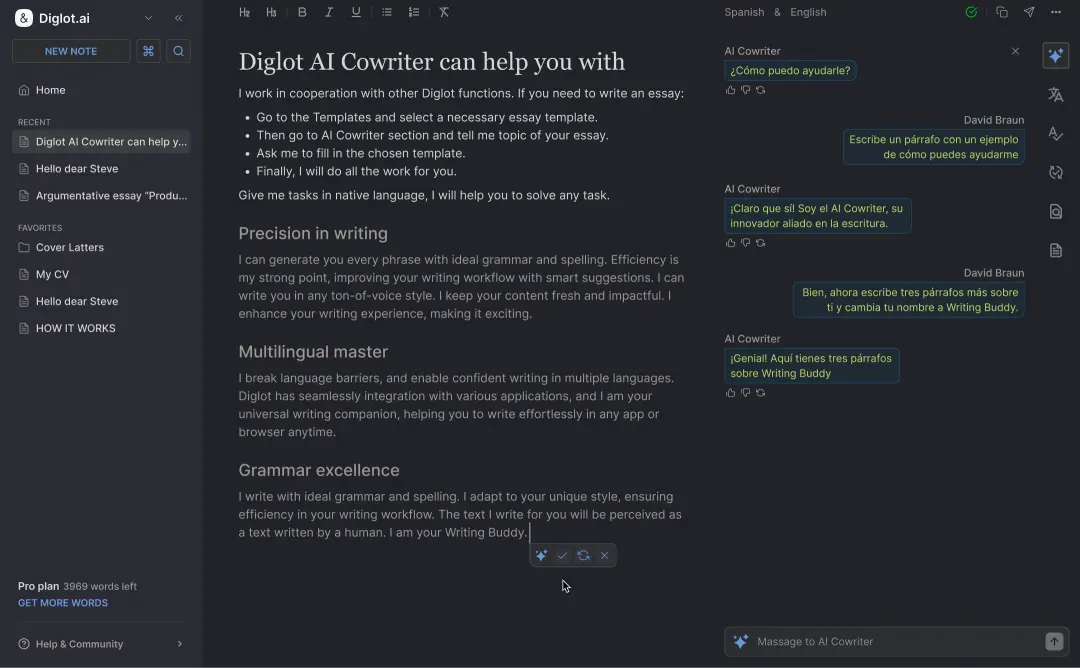
Diglot is built for the bilingual workflow, where you think in Chinese and write in English. That is exactly where missing articles, "two book", and "open the light" come from. Instead of only flagging a mistake, it shows the natural version and the reason, so you learn the pattern instead of repeating it.
- Catch L1-transfer errors in context. The grammar checker for Chinese speakers is tuned for the article, plural, tense, and pronoun slips above, the ones a generic checker often misses.
- Find the sentences that read translated. The sounds-translated checker highlights the word-for-word phrasing, calques, and topic-first sentences that native readers stumble on.
- Rewrite them naturally. The Chinese-speaker paraphrasing tool turns word-for-word translations into natural English while keeping your meaning.
- Learn, do not just accept. Each suggestion explains the fix, so your next draft has fewer of the same mistakes.
Your English is already good enough to communicate. Closing this short list of grammar gaps is what makes it read as fluent. Add the article, mark the plural, put the tense on the verb, and your writing stops sounding translated and starts sounding like you.