

In this article
Different grammar, predictable errors
If you are a Japanese speaker writing English, your mistakes are not random. Japanese is verb-final and topic-prominent. It marks grammar with particles instead of word order, has no articles, does not require plural marking, and drops any subject the context makes clear. It also carries thousands of English loanwords whose meanings drifted after arrival. English works differently on every one of those points.
That contrast is what makes the common English mistakes Japanese speakers make so consistent: the same nine patterns show up in emails, papers, and reports from Tokyo to Toronto. This first-language fingerprint is called L1 interference, and because it is systematic, it is fixable. Here are the patterns, the Japanese habit behind each one, and the fast fix. It is consistent enough that a free tool can often spot the fingerprints your first language leaves on a paragraph of English.
1. Missing or misused articles (a, an, the)
Japanese has no article system. Whether a noun is definite or indefinite is left to context, so articles get dropped entirely or added by feel. This is the single most frequent Japanese-English error, and it survives well into advanced levels.
Off: "I attended meeting and submitted report to manager."
Native: "I attended the meeting and submitted the report to my manager."
A useful habit: first mention of a countable thing usually takes "a" or "an", and a thing your reader can already identify takes "the". Scan every singular countable noun in your draft. In Japanese-English writing, most bare nouns are missing an article.
2. Missing plural -s
Japanese nouns do not change for number. 本 (hon) is "book" or "books"; a counter word or the context tells you how many. So the English plural -s feels redundant and quietly disappears, and sometimes gets added to nouns that never take it.
Off: "I reviewed two document and collected many informations."
Native: "I reviewed two documents and collected a lot of information."
If there is more than one, add -s. But keep information, equipment, advice, and furniture singular; they are uncountable in English no matter how many pieces you mean.
3. Dropped subjects and the "As for" opener
Japanese is a topic-prominent, pro-drop language. The particle は (wa) marks the topic, and any subject the listener can recover is simply omitted: 行った (itta, "went") is a complete sentence. English demands an explicit subject in nearly every clause, so direct transfer produces fragments — or, from learners taught that は means "as for", a wall of "As for" openers.
Off: "Checked the data yesterday. Found a problem in section 3."
Native: "I checked the data yesterday. I found a problem in section 3."
Off: "As for the results, they were good. As for the schedule, it is tight."
Native: "The results were good. The schedule is tight."
Give every sentence a subject, and let the topic be the subject. "As for" is grammatical English, but it belongs in occasional contrasts, not at the head of every sentence. When it opens a paragraph three times in a row, readers feel the Japanese structure underneath.
4. Yes and no to negative questions
This one causes real-world confusion, not just awkwardness. Japanese はい (hai) means "what you said is correct"; English "yes" means "the positive version is true". The two systems agree on positive questions and collide on negative ones.
Question: "You didn't finish the report?"
Off: "Yes." (meaning: that's right, I didn't finish)
Native: "No, I didn't." (or "Yes, I did," if you finished)
The fix is mechanical: ignore the shape of the question and answer the fact. Finished means "Yes, I did." Not finished means "No, I didn't." Always attach the short clause, so the reader cannot misread you even if the yes or no slips.
5. Stacked hedging ("I think it might be perhaps...")
Japanese softens assertions as a matter of politeness: かもしれない (kamoshirenai, "might"), と思います (to omoimasu, "I think"), and たぶん (tabun, "probably") layer naturally and read as considerate. Carried into English, the layers stack into sentences that sound unsure rather than polite.
Off: "I think that it might be perhaps a little difficult to finish by Friday."
Native: "It may be difficult to finish by Friday." (or, honestly: "We can't finish by Friday.")
English politeness lives in framing, not in stacked qualifiers. Pick one hedge ("may", "I think", or "probably") and delete the rest. Your writing will sound more confident and, to English readers, more trustworthy.
6. Katakana false friends (wasei-eigo)
Japanese absorbed thousands of English words into katakana, and many shifted meaning after arrival. Because they feel like English, they get written into English with full confidence, and they are the most misleading words a Japanese speaker owns. Each one is a classic false cognate: same form, different meaning.
| Katakana | What it means in Japanese | Natural English |
|---|---|---|
| マンション (manshon) | an apartment / condo | apartment, condo — not "mansion" |
| クレーム (kurēmu) | a complaint | complaint — not "claim" |
| スマート (sumāto) | slim, stylish | slim, slender — not "smart" |
| テンション (tenshon) | energy, excitement level | energy, spirits — not "tension" |
| カンニング (kanningu) | cheating on a test | cheating — not "cunning" |
| サイン (sain) | a signature | signature — not "sign" |
So "My mansion is small" tells an English reader you live in a modest palace, and "We received a claim from the customer" sounds like a legal filing rather than a complaint. When a word arrived through katakana, verify it before you trust it.
7. "Almost Japanese people"
Japanese ほとんど (hotondo) covers both "almost" and "most", and it modifies nouns directly: ほとんどの人 (hotondo no hito, "most people"). English "almost" is an adverb and cannot sit in front of a bare noun, so the direct mapping produces one of the clearest signatures of Japanese-English writing.
Off: "Almost Japanese people agree with this idea."
Native: "Almost all Japanese people agree with this idea." (or "Most Japanese people agree.")
The rule: "almost" needs "all", "every", or "everyone" after it. If you don't want the extra word, switch to "most". As a plain adverb it is fine: "I almost missed the train."
8. L/R slips that reach the page
Japanese has one liquid consonant, the ら/り/る/れ/ろ row, pronounced between English /l/ and /r/. Because both English sounds collapse into one Japanese category, the contrast is genuinely hard to hear, and that uncertainty leaks from speech into spelling.
Off: "We discussed the erection results and our grobal strategy."
Native: "We discussed the election results and our global strategy."
The dangerous swaps are the ones that form real words (election/erection, correct/collect, glass/grass, lock/rock), because a spellchecker sails right past them. Keep a personal list of the pairs you actually confuse and search your draft for them before sending.
9. Over-nominalization ("make an investigation of")
Formal Japanese leans on noun + する (suru, "do") constructions such as 調査する (chōsa suru, "do an investigation") and 確認する (kakunin suru, "do a confirmation"), and academic Japanese prizes noun-heavy style. Translated directly, English drafts fill up with "make an examination of" and "perform an implementation of" where a single verb would do.
Off: "We will make an investigation of the cause and perform a confirmation of the data."
Native: "We will investigate the cause and confirm the data."
When you see "make/do/perform/conduct + a + noun", check whether the noun has a verb form. It usually does, and the verb version is shorter, clearer, and more natural.
A quick self-check before you send
| Check | What to look for |
|---|---|
| Articles | Does each singular countable noun have a, an, or the? |
| Plurals | Is every "more than one" marked with -s? Keep information singular. |
| Subject | Does every sentence have one? Do not drop I, it, or there. |
| "As for" | More than once per page? Make the topic the subject instead. |
| Negative questions | Answer the fact: "No, I didn't" / "Yes, I did" — clause attached. |
| Hedges | One per sentence. Cut "I think that it might be perhaps". |
| "Almost" | Before a noun, change it to "almost all" or "most". |
| Katakana words | Mansion, claim, smart, tension, sign — verify the English meaning. |
| L/R pairs | Search for your personal swaps: election/erection, collect/correct. |
Wondering how many of these your own draft has? Run it through the sounds-translated checker. It flags the patterns that make English read like translated Japanese.
How Diglot helps Japanese speakers
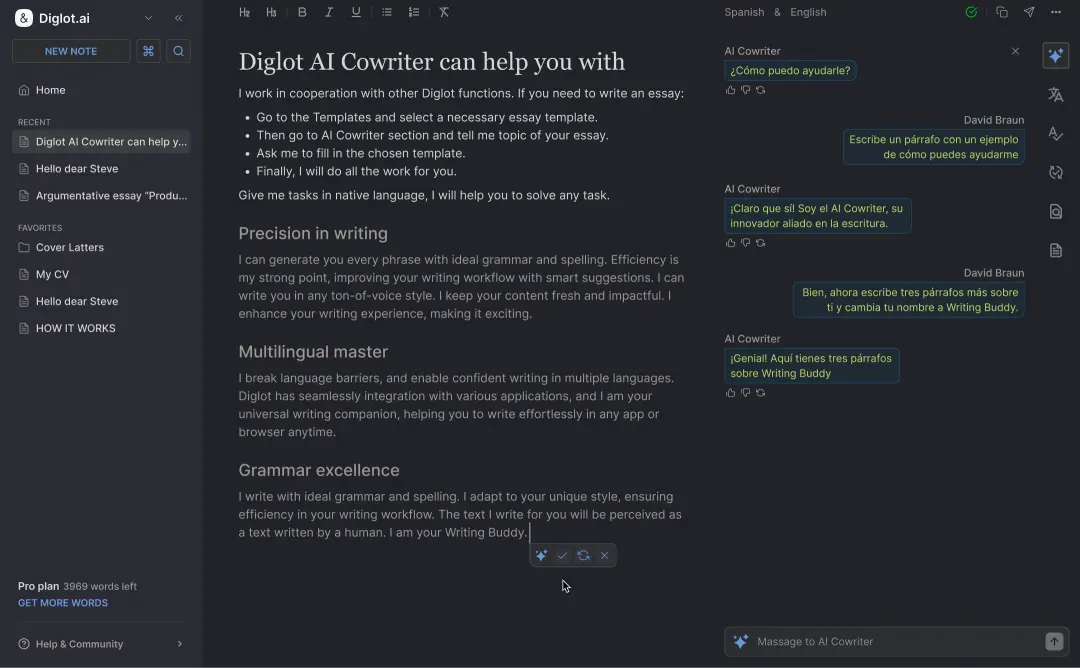
Diglot is built for the bilingual workflow, where you think in Japanese and write in English. That is exactly where missing articles, dropped subjects, and katakana false friends come from. Instead of only flagging a mistake, it shows the natural version and the reason, so you learn the pattern instead of repeating it.
- Catch L1-transfer errors in context. The grammar checker for Japanese speakers is tuned for the article, plural, subject, and hedging slips above, the ones generic checkers under-flag.
- Write in both languages at once. Weave for Japanese lets you draft in Japanese and English in the same document and converge on natural English without losing your meaning.
- Learn, do not just accept. Each suggestion explains the fix, so your next draft has fewer of the same mistakes. And keeping your own voice matters: one study found AI detectors falsely flagged 61% of TOEFL essays as AI-written (Liang et al., Patterns, 2023), which is what happens when non-native writing gets over-sanitized into generic English.
- See the other language patterns. Japanese is one of many first languages with a predictable English fingerprint. Browse the full common English mistakes hub to compare.
Your English is already good enough to communicate. Closing this short list of grammar gaps is what makes it read as fluent. Add the article, restore the subject, cut the extra hedge, double-check the katakana, and your writing stops sounding translated and starts sounding like you.