


In this article
Different grammar, predictable errors
If you are a Korean speaker writing English, your mistakes follow a pattern set by your first language. Korean is verb-final and agglutinative. It uses particles instead of prepositions, has no articles, does not require plural marking, and freely drops subjects that context makes clear. English does almost the opposite of each.
That contrast is what makes the common English mistakes Korean speakers make so consistent — and so fixable. On top of the grammar, there is Konglish: English loanwords that drifted to new meanings inside Korean. Below are the ten patterns that cause the most trouble, each with the Korean habit behind it and a fast fix. The set is consistent enough that a free tool can often see which mistakes give your first language away in a short sample.
1. Missing or misused articles (a, an, the)
Korean has no article system, so articles get added or dropped by guesswork. This is the most-cited Korean error of all.
Off: "I went to store and bought apple."
Native: "I went to the store and bought an apple."
A useful habit: first mention of a countable thing usually takes "a" or "an", and a thing you have already named takes "the". The full system is in the guide to a, an, and the for article-less languages.
2. Missing plural -s
Korean does not require a plural ending; number comes from context. So the English -s drops off, and irregular plurals sometimes get over-regularized.
Off: "Three student came and two childrens stayed."
Native: "Three students came and two children stayed."
If there is more than one, add -s — but not to uncountable nouns like information or homework.
3. Prepositions (the particle trap)
Korean particles do not line up with English prepositions. A single particle can surface as in, on, at, or to, so the choice feels random.
Off: "I'm interested at science and I arrived to the airport."
Native: "I'm interested in science and I arrived at the airport."
Learn the verb together with its preposition: interested in, arrived at, married to, depends on.
4. Dropping the subject (and over-using the passive)
Korean omits subjects and objects that are understood. English needs them in almost every clause. To avoid naming a subject, writers often reach for the passive voice.
Off: "Went to the store. Bought food. Was tired."
Native: "I went to the store. I bought food. I was tired."
Off: "The meeting was held and the report was discussed."
Native: "We held the meeting and discussed the report."
Give every sentence a clear subject, and prefer the active voice.
5. Verb tense and "since" versus "for"
Korean encodes tense and aspect differently, so the present continuous shows up where simple present belongs, and the present perfect gets mishandled.
Off: "I am studying English since 3 years."
Native: "I have been studying English for 3 years."
Use "for" with a length of time and "since" with a starting point, both with the present perfect.
6. Subject-verb agreement (the third-person -s)
Korean verbs do not conjugate for person or number, so the third-person singular -s is the most reliably dropped ending.
Off: "My brother speak English. He always go to the gym."
Native: "My brother speaks English. He always goes to the gym."
If the subject is he, she, or it, the present verb usually takes -s.
7. Word order in questions and clauses
Korean is verb-final and puts modifiers before the noun, so default English order and question inversion get disrupted.
Off: "Yesterday I to the park went."
Native: "Yesterday I went to the park."
English wants subject, verb, then object. Inside a question word clause, keep statement order: "where the station is", not "where is the station".
8. "Almost" in front of a noun
Korean lets 거의 (almost) modify a noun directly. English does not, so "almost" needs "all" or a switch to "most".
Off: "Almost students passed the exam."
Native: "Almost all students passed the exam." (or "Most students passed.")
This is a clear signature of Korean-English writing, and an easy one to clean up.
9. Countable and uncountable nouns
Korean does not split count and mass nouns the way English does, so mass nouns get pluralized and much / many / very get swapped.
Off: "I have many homeworks and he gave me many informations."
Native: "I have a lot of homework and he gave me a lot of information."
Off: "I very like it."
Native: "I really like it." (or "I like it very much.")
10. Konglish and direct translation
English loanwords carry shifted meanings in Korean and surface confidently in writing. The table below has the most common ones.
| Konglish | What it means in Korean | Natural English |
|---|---|---|
| hand phone | a mobile phone | cell phone / mobile phone |
| fighting! (hwaiting) | "You can do it!" | Good luck! / You've got this! |
| service | a free, complimentary item | something on the house / a free gift |
| meeting | a group blind date | blind date / group date |
| eye shopping | browsing without buying | window shopping |
| notebook | a laptop computer | laptop |
| SNS | social media generally | social media |
| one-piece | a dress | dress |
Direct translation causes related slips: "His height is tall" should be "He is tall", and "This pizza's taste is good" should be "This pizza tastes good".
A quick self-check before you send
| Check | What to look for |
|---|---|
| Articles | Does each singular countable noun have a, an, or the? |
| Plurals | Is every "more than one" marked with -s? Keep information singular. |
| Subject | Does every sentence have one? Do not drop I, it, or there. |
| Agreement | He, she, it take the -s verb: he runs, she goes. |
| Prepositions | Verify the pair: interested in, arrived at, married to. |
| "Almost" | Before a noun, change it to "almost all" or "most". |
| Konglish | Hand phone, service, SNS, fighting — swap for the English word. |
How Diglot helps Korean speakers
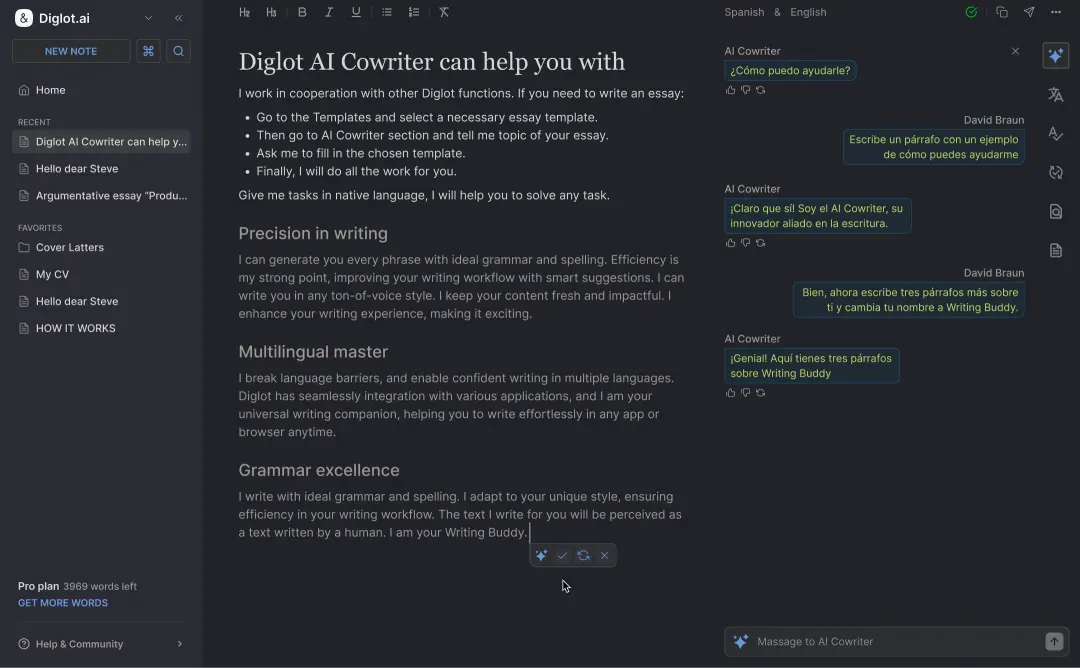
Diglot is built for the bilingual workflow, where you think in Korean and write in English. That is exactly where missing articles, dropped subjects, and Konglish come from. Instead of only flagging a mistake, it shows the natural version and the reason, so you learn the pattern.
- Catch L1-transfer errors in context. The grammar checker for Korean speakers is tuned for the article, plural, subject, and agreement slips above.
- Rewrite translated-sounding sentences. The Korean-speaker paraphrasing tool turns word-for-word translations into natural English while keeping your meaning.
- Learn, do not just accept. Each suggestion explains the fix, so your next draft has fewer of the same mistakes. See why translated text reads off in why your English sounds translated.
- One workspace for the whole task. Explore the full ESL writing tool built for non-native writers.
Your English is already good enough to communicate. Closing this short list of grammar gaps is what makes it read as fluent. Add the article, restore the subject, fix the preposition, and your writing stops sounding translated and starts sounding like you.
Try the grammar checker for Korean speakers