


In this article
Close languages, predictable traps
If you are a Spanish speaker writing English, your mistakes look different from a Korean or Chinese speaker's. Spanish and English share the same basic word order and thousands of Latin-root words, so you can often translate a sentence almost word for word and get away with it. The trouble starts exactly where the two languages quietly disagree.
That is why the common English mistakes Spanish speakers make are so consistent: they are not random slips but L1 interference, your first language's rules leaking into your second. Spanish drops subjects, stacks negatives, uses "have" for age, puts "the" before abstract ideas, and is full of words that look English but mean something else. Below are the nine patterns that cause the most trouble, each with the Spanish habit behind it and a fast fix. Those patterns are consistent enough that a free tool can often spot your first-language fingerprints in a paragraph of English.
1. The dropped subject ("Is important that...")
Spanish is a pro-drop language: the verb ending already tells you who the subject is, so "es importante" and "está lloviendo" need no pronoun at all. English requires a subject in almost every clause — even an empty "it" that means nothing and only fills the slot.
Off: "Is important to arrive early. Is raining, so we stayed home."
Native: "It is important to arrive early. It is raining, so we stayed home."
The fix is mechanical: every English clause needs a subject. If there is no real one, use "it" or "there": "It seems difficult", "There are two options".
2. "I have 25 years" — the tener idioms
Spanish builds a whole family of states on tener (to have): tengo 25 años, tengo hambre, tengo frío, tienes razón. English builds the same states on "to be", so the direct translation sounds like you own your age.
Off: "I have 25 years, I have hunger, and you have reason."
Native: "I am 25 years old, I am hungry, and you are right."
Memorize the swap as a set: tener hambre → be hungry, tener frío → be cold, tener miedo → be afraid, tener sueño → be sleepy, tener suerte → be lucky, tener razón → be right. If the Spanish version uses tener for a state, the English version almost certainly uses "be" plus an adjective.
3. "The happiness is important" — the extra "the"
Spanish puts the definite article in front of general concepts: la felicidad, el dinero, los perros. English does the opposite: general statements drop the article entirely.
Off: "The happiness matters more than the money. The dogs are loyal animals."
Native: "Happiness matters more than money. Dogs are loyal animals."
The rule of thumb: talking about the thing in general, no article; talking about a specific one, use "the". "The happiness I felt that day" is correct because it is one particular happiness, not the concept.
4. "I didn't see nothing" — double negatives
In Spanish, negative concord is not just allowed, it is required: "no vi nada" and "no conozco a nadie" are the only grammatical ways to say those sentences. Translated literally, they come out as "I didn't see nothing" and "I don't know nobody" — which standard English reads as errors.
Off: "I didn't see nothing, and I don't know nobody here."
Native: "I didn't see anything, and I don't know anybody here."
Keep one negative per clause. Once "not" is in the sentence, switch the rest to any-words: anything, anybody, anywhere, ever.
5. Depends of, married with, dream with — prepositions
Spanish verbs drag their own prepositions into English: depender de, casarse con, soñar con. Each one is correct in Spanish and wrong in English.
Off: "It depends of the weather. She is married with a doctor. I dream with living abroad."
Native: "It depends on the weather. She is married to a doctor. I dream of living abroad."
There is no shortcut here: learn the verb together with its English preposition as one unit — depends on, married to, dream of, consists of, arrive at. Translating the Spanish preposition is what creates the error in the first place.
6. "People is" — the singular gente
The Spanish word for people, la gente, is a grammatically singular collective: "la gente es amable" takes a singular verb. English "people" is plural, always.
Off: "People is very friendly in my city."
Native: "People are very friendly in my city."
Note that English is not simply "always plural" here: everybody and everyone stay singular ("everybody is welcome"). The specific fix is narrow: people takes are, were, have.
7. "I am agree" — the extra "to be"
Spanish expresses agreement as a state: estar de acuerdo, literally "to be in agreement". English "agree" is a plain verb that needs no "be" in front of it. The Spanish structure sneaks in and produces one of the most recognizable signatures of Spanish-English writing.
Off: "I am agree with you, and my colleagues are agree too."
Native: "I agree with you, and my colleagues agree too."
If you catch yourself writing "am/is/are agree", delete the "be". The same instinct — reaching for "to be" because Spanish frames the idea as a state — is worth watching in general: English often wants a plain verb where Spanish wants estar plus a phrase.
8. Comma splices and mile-long sentences
Spanish prose comfortably chains several full clauses with commas; a long, comma-linked sentence reads as elegant, not sloppy. English expects shorter sentences and treats a comma splice — two complete sentences joined only by a comma — as a punctuation error.
Off: "The results were surprising, we did not expect them, the sample was too small to be sure."
Native: "The results were surprising; we did not expect them. The sample was too small to be sure."
Where the comma joins two complete thoughts, replace it with a period, a semicolon, or a connector like "because" or "so". If your paragraphs still feel foreign after that, run them through the sounds-translated checker — long, comma-chained sentences are one of the strongest signals it looks for.
9. False friends: actualmente, embarazada, asistir
Because Spanish and English share so much Latin vocabulary, look-alike words feel automatic — and many of them drifted to different meanings centuries ago. These are false cognates, and they produce sentences that are perfectly grammatical and completely wrong.
Off: "Actually I work in Madrid, and last week I assisted to a conference."
Native: "Currently I work in Madrid, and last week I attended a conference."
| Spanish word | What it really means | The English look-alike means |
|---|---|---|
| actualmente | currently, nowadays | actually = in fact (en realidad) |
| embarazada | pregnant | embarrassed = avergonzada |
| asistir | to attend | assist = to help (ayudar) |
| realizar | to carry out, to achieve | realize = to become aware (darse cuenta) |
| carpeta | a folder | carpet = alfombra |
| éxito | success | exit = salida |
| sensible | sensitive | sensible = sensato, practical |
| librería | bookstore | library = biblioteca |
The pattern to internalize: the more automatic a Latin-looking word feels, the more it deserves a second look. "She was embarazada by the question" is a sentence no spell-checker will flag.
A quick self-check before you send
| Check | What to look for |
|---|---|
| Subjects | Does every clause have one? Add the dummy "it": It is raining. |
| Have vs. be | Age, hunger, cold, fear, being right — all take "be", not "have". |
| Articles | General concept? Drop "the": Happiness is important. |
| Negatives | One per clause. After "not", use anything / anybody / ever. |
| Prepositions | Depends on, married to, dream of, consists of. |
| People | Always plural: people are, people were. |
| False friends | Actually, assist, realize, sensible — verify against the table above. |
How Diglot helps Spanish speakers
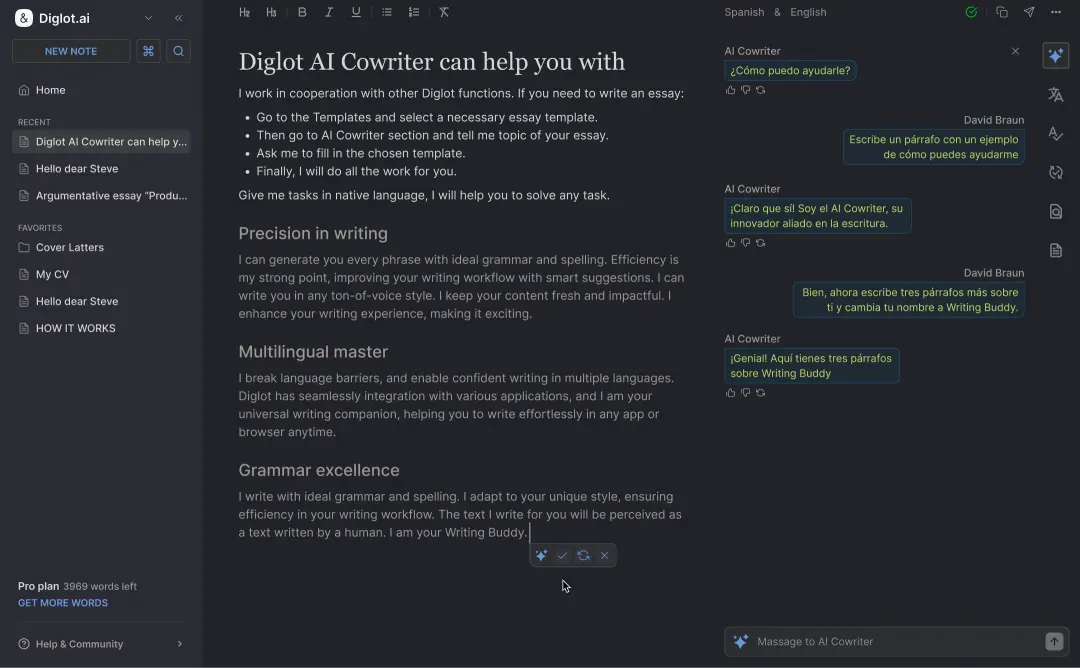
Diglot is built for the bilingual workflow, where you think in Spanish and write in English. That is exactly where "I have 25 years", "is important that", and "I am agree" come from. Instead of only flagging a mistake, it shows the natural version and the reason behind it, so you learn the pattern instead of repeating it. And when a whole sentence comes out grammatically correct but still sounds translated, the paraphrasing tool for Spanish speakers rewrites it into natural English while keeping your meaning intact.
- Catch L1-transfer errors in context. The grammar checker for Spanish speakers is tuned for the dropped subjects, tener-idioms, preposition slips, and agreement errors above.
- Spot false friends before your reader does. Words like actualmente and asistir are grammatically fine and semantically wrong — exactly the class of error that generic checkers miss.
- Build real English vocabulary in context. Diglot Weave for Spanish mixes English words into Spanish text gradually, so new vocabulary arrives with its natural grammar attached — including the right preposition.
- Learn, do not just accept. Each suggestion explains the fix, so your next draft has fewer of the same mistakes.
Your English is already good enough to communicate. Spanish speakers start closer to English than most learners, and closing this short list of transfer gaps is what makes your writing read as fluent. Restore the "it", swap have for be, keep one negative, and check the Latin look-alikes, and your English stops sounding translated and starts sounding like you.