

In this article
Different grammar, predictable errors
If you are a Vietnamese speaker writing English, your mistakes are not random. Vietnamese is an isolating language: words never change form. Tense lives in separate particles, plurality comes from numbers and classifiers, adjectives work as verbs without "to be", and there are no articles at all. English packs all of that into word endings and small function words — exactly the parts Vietnamese never asks you to think about.
That is why the common English mistakes Vietnamese speakers make are so consistent, and why L1 interference is the right lens for fixing them: change the habit, not just the sentence. Below are the nine patterns that cause the most trouble, each with the Vietnamese logic behind it and a fast fix. The patterns are consistent enough that a free tool can often detect the native language behind your English from a short sample.
1. Unmarked tense ("Yesterday I go to school")
Vietnamese verbs have exactly one form. Time is expressed with particles (đã for the past, đang for something in progress, sẽ for the future) or simply inferred from a time word. Hôm qua tôi đi học, literally "Yesterday I go school", is perfect Vietnamese. So the English verb stays bare even when the sentence clearly points to the past.
Off: "Yesterday I go to the market and buy some fruit."
Native: "Yesterday I went to the market and bought some fruit."
The fix is a habit shift, not a rule to memorize: in English the time word is not enough; the verb itself must carry the tense. Whenever you write a time expression like yesterday, last week, or in 2019, scan the clause and move every verb into the past form. In Vietnamese, a single marker like hôm qua or đã covers the whole sentence; English makes every verb repeat it.
2. Missing plural -s (classifier logic)
Vietnamese counts with classifiers: ba con mèo is "three [animal] cat", hai cuốn sách is "two [book-shaped-object] book". The noun never changes, because the number already tells you how many. English keeps the number and still demands the -s, which feels redundant if your first language is Vietnamese.
Off: "Three student joined the class and borrowed five book."
Native: "Three students joined the class and borrowed five books."
Rule of thumb: if there is more than one, the noun takes -s even when a number sits right in front of it. The exceptions are uncountable nouns such as information, homework, advice, and equipment, which stay singular no matter how much of them you have.
3. Dropped "to be" before adjectives ("She very beautiful")
In Vietnamese, adjectives are stative verbs. Cô ấy đẹp — literally "She beautiful" — is a complete, grammatical sentence, and inserting a linking verb would actually be wrong. Transferred to English, the copula simply vanishes.
Off: "She very beautiful. The food in this restaurant delicious."
Native: "She is very beautiful. The food in this restaurant is delicious."
Check every sentence whose predicate is an adjective: beautiful, tired, expensive, difficult. In English each one needs is, am, are, was, or were in front of it. Quick test: if your sentence has no verb at all, the missing word is almost always a form of "to be".
4. Missing articles (a, an, the)
Vietnamese has no article system. Definiteness comes from context, word order, or demonstratives like này (this) and đó (that). So English articles get dropped entirely, or sprinkled in by guesswork.
Off: "I bought book at store near my house."
Native: "I bought a book at the store near my house."
A working shortcut: the first mention of a countable thing usually takes "a" or "an"; once you have named it, or when both you and your reader know exactly which one you mean, it takes "the". Scan every singular countable noun in your draft: in Vietnamese-English writing, most of the bare ones need an article.
5. Pronoun trouble: dropped subjects and repeated names
Vietnamese personal reference is built on social relationships. Instead of neutral pronouns, speakers pick a kinship term by relative age and status: anh (older brother), chị (older sister), em (younger person), cô (aunt). Or they use the person's name. Or they drop the reference entirely when context makes it obvious. English "you" and "she" feel blunt and socially flat by comparison.
Two things happen in English writing. First, subjects get dropped the way Vietnamese allows. Second, writers repeat a name over and over to avoid committing to a pronoun.
Off: "Went to the meeting late. Was very crowded."
Native: "I went to the meeting late. It was very crowded."
Off: "Ms. Lan reviewed the report. Ms. Lan found two errors. Ms. Lan sent the report back."
Native: "Ms. Lan reviewed the report. She found two errors and sent it back."
English needs an explicit subject in nearly every clause, and it expects you to switch to a pronoun after the first mention. Neither choice carries any social meaning in English: "she" is not disrespectful, it is just grammar.
6. Vanishing -ed and -s endings in writing, not just speech
Vietnamese syllables end in a small set of final sounds, and final consonant clusters do not exist. Endings like the /kt/ in "worked" or the /ts/ in "wants" are patterns Vietnamese phonology never produces, so they get dropped in speech. The surprising part: they disappear on the page too. Writers rehearse sentences in their inner voice, and an ending that is never spoken is easy to leave out of an email, even when you know the rule cold.
Off: "Last night she watch a movie, then she call her friend."
Native: "Last night she watched a movie, then she called her friend."
This overlaps with mistake #1 but has a different cause and needs a different fix. Proofread visually, not by ear: scan the ends of your verbs specifically, because your inner voice will read "watch" and "watched" identically. This is one place a grammar checker built for Vietnamese speakers earns its keep: the errors are systematic, so they are catchable.
7. Preposition mismatches ("on the morning")
Vietnamese prepositions carve up space and time differently from English. Trên covers much of English "on" and "above"; ở marks location in general; vào introduces points in time. None of them map one-to-one, so English prepositions come out half-translated.
Off: "I will call you on the morning. She is good in English."
Native: "I will call you in the morning. She is good at English."
Do not translate the Vietnamese preposition. Memorize English pairings as single units: in the morning, on Monday, at night, good at, interested in, depend on, listen to. For time, a size rule helps: in for long stretches (months, years, mornings), on for days and dates, at for clock times.
8. "Yes" to a negative question (the dangerous one)
Vietnamese answers a negative question by agreeing or disagreeing with the person asking. Asked "Em chưa ăn à?" ("You have not eaten yet?"), you answer vâng ("yes") to confirm: "correct, I have not eaten." English works the opposite way — yes and no track the fact itself, no matter how the question was phrased.
Off: Boss: "So you didn't send the invoice?" — You: "Yes." (meaning: correct, I did not send it)
Native: "No, I didn't send it yet." (or "Yes, I did send it", if you did)
This mistake does not just sound foreign — it transmits the wrong information, which makes it the most consequential item on this list for work emails and meetings. The safest fix: never answer a negative question with a bare yes or no. Always attach the full clause ("No, I didn't" or "Yes, I did") so the meaning survives even if your yes/no instinct flips.
9. "Too" where "very" belongs (the quá trap)
The Vietnamese intensifier quá means "very, so, extremely" and often carries an admiring tone: Đẹp quá! is "So beautiful!" Its closest-looking English translation is "too". But English "too" always signals an excess, something negative that prevents or spoils.
Off: "The party was too fun! Your English is too good."
Native: "The party was so much fun! Your English is really good."
The test: English "too" implies a problem (too expensive to buy, too tired to drive). If you mean a compliment or plain emphasis, use very, really, or so. It works like a false cognate: "too" looks like the direct equivalent of quá, but the meanings split long ago, and the English word says something you do not intend.
A quick self-check before you send
| Check | What to look for |
|---|---|
| Tense | Time word in the sentence? Every verb must match it: went, not go. |
| Plurals | More than one? Add -s, even right after a number: three students. |
| "To be" | An adjective as predicate needs is/are: "The food is delicious." |
| Articles | Every singular countable noun gets a, an, or the. |
| Subject | Every clause has one; switch to a pronoun after the first mention. |
| Endings | Proofread verb endings by eye — your inner voice drops -ed and -s. |
| Prepositions | In the morning, on Monday, at night, good at, listen to. |
| Negative questions | Answer the fact, with a full clause: "No, I didn't." |
| "Too" | Compliment or emphasis? Use very / really / so, not too. |
How Diglot helps Vietnamese speakers
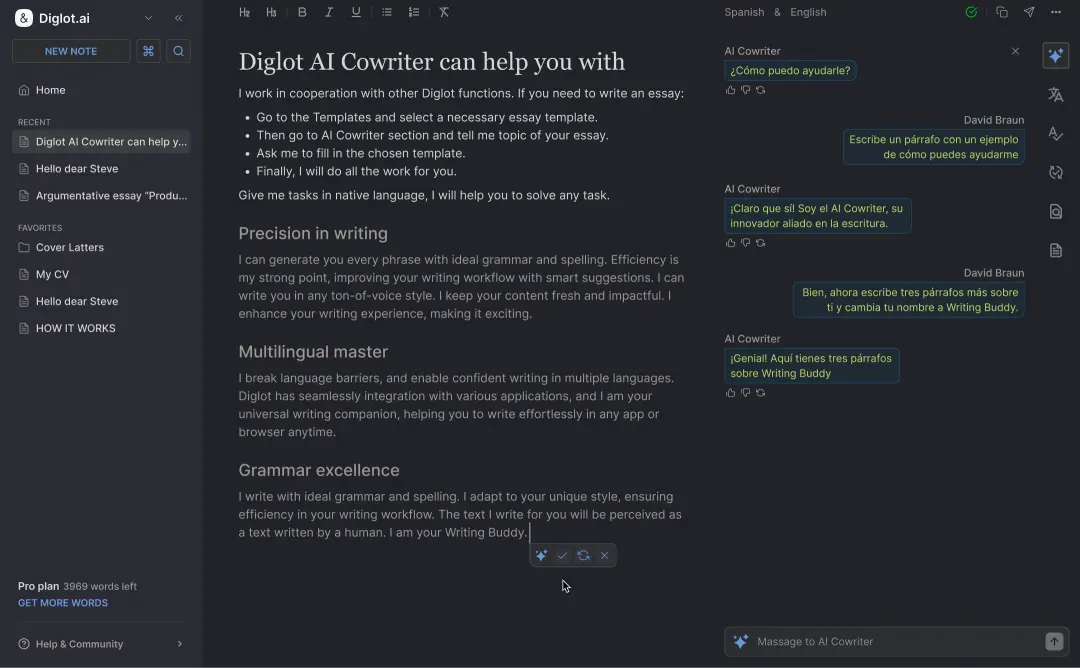
Diglot is built for the bilingual workflow, where you think in Vietnamese and write in English. That is exactly where bare verbs, missing -s, dropped "to be", and quá-flavored "too" come from. Instead of only flagging a mistake, it shows the natural version and the reason, so you learn the pattern instead of repeating it.
- Catch L1-transfer errors in context. The grammar checker for Vietnamese speakers is tuned for the tense, plural, copula, and article slips above.
- Test whether your writing sounds translated. Run a paragraph through the sounds-translated checker to see which sentences still carry Vietnamese structure.
- See how your patterns compare. Browse mistakes by language on the common English mistakes hub. The Vietnamese set is distinctive, but the article and preposition traps are shared with half the world.
One more reason to write in your own voice and fix the grammar, rather than machine-translating: AI detectors already misread non-native writing. Liang et al. (Patterns, 2023) found that 61% of TOEFL essays written by real people were falsely flagged as AI-generated. Clean, natural English that is unmistakably yours is the best defense.
Your English is already good enough to communicate. Closing this short list of grammar gaps is what makes it read as fluent. Mark the tense, add the -s, restore the "is", and answer the negative question with a full clause, and your writing stops sounding translated and starts sounding like you.