


In this article
Runglish is the informal name for English shaped by Russian: articles that go missing or appear where they should not, constructions like “I very like it”, word-for-word calques such as “make a photo”, false friends like magazine (магазин means shop, not periodical), and word order that still carries Russian intonation. It is not broken English. It is systematic first-language transfer — every pattern has a precise cause in Russian grammar, which means every pattern is predictable, and anything predictable is fixable. This guide catalogs the classic patterns, explains where each one comes from, and gives a targeted fix for each.
One disclosure before we start: I write Runglish natively. Russian and Ukrainian are my first languages, English arrived later, and every example in this article is something I have either said, written, or caught myself about to write. So read this as an insider’s field guide, not a list of errors compiled by someone who has never made them.
Where the word comes from
“Runglish” and its sibling “Russlish” have been floating around for decades. Arthur C. Clarke joked about a “Stamp Out Russlish!” campaign aboard a spacecraft with a mixed Russian-American crew in one of his Odyssey novels back in the 1980s, and when real mixed crews started living together on the International Space Station around 2000, cosmonauts reportedly joked that the language they actually spoke up there was Runglish. Down on Earth, the Russian-speaking community around Brighton Beach in New York has spoken its own blend for generations — English nouns wired into Russian grammar, Russian syntax wearing English clothes.
The word covers two different things, and it helps to keep them apart. One is a community dialect: people who share both languages mixing them deliberately, because a blend is efficient when everyone around you speaks it. The other is transfer: a Russian speaker writing English for readers who do not know Russian, with the grammar of the first language quietly leaking into the second. The first is a feature. The second is what this guide is about — because when your reader cannot see the Russian underneath, the leak just reads as a mistake.
The classic patterns
Missing and extra articles
Russian has no articles. None. The distinction English carries with a and the — is this thing new to the conversation, or already known? — Russian carries through context and word order. So a Russian speaker’s brain simply does not fire a signal when an article is needed, and you get “I bought car” or “send me report”.
The overcorrection is just as characteristic: once you learn that English loves articles, you start inserting the in front of abstractions where English drops it: “the life is unfair”, “the nature is beautiful”. Both directions are the same pattern: the article system is not native to your grammar, so you are running it manually.
The fix that actually works: do not try to memorize every article rule at once. Install one routine: every time you write a singular countable noun, stop and choose a, the, or a reason to have neither. That single checkpoint catches the majority of article errors, because bare singular countable nouns (“I bought car”) are the most visible Runglish signature there is.
”I very like it”
In Russian, очень (very) happily modifies verbs: очень люблю, очень хочу. In English, very only modifies adjectives and adverbs — verbs need really, very much, or a restructure. So “I very like this idea” is a perfect calque of я очень люблю эту идею, and it is one of the most recognizable Runglish constructions in existence.
Fix: very + verb is never correct in English. Swap in really before the verb, or move very much to the end: “I really like it”, “I like it very much”.
Calques: Russian sentences wearing English words
A calque is a word-for-word translation of a phrase that exists in one language but not the other. The words are English; the sentence is still Russian. The classics:
- “Make a photo” (сделать фото) — English takes photos.
- “I feel myself fine” (чувствую себя хорошо) — English drops the reflexive: “I feel fine”. The Runglish version is unintentionally funny to native ears, which is exactly why it gets remembered.
- “I am agree” (я согласен) — in Russian, agreement is an adjective, so the verb to be comes along for the ride. In English, agree is the verb itself: “I agree”.
- “It depends from” (зависит от) — English says depends on.
- “On the picture” (на картинке) — English puts things in the picture.
- “Make a conclusion” (сделать вывод) — English draws conclusions.
- “How are you?” — “Normal.” (нормально) — grammatically fine, socially strange. English small talk expects “fine” or “good”; “normal” sounds like a lab result.
Fix: when an English sentence comes out of you suspiciously fast and fluent, back-translate it. If it maps onto Russian word for word, treat it as a suspect until you have checked the verb and the preposition. Calques feel more natural than correct English precisely because they are your native syntax in disguise.
False friends
A false cognate is a word that looks identical across languages and means something different. Russian borrowed heavily from French, German, and English at different times, and the meanings drifted. The result is a minefield of words that feel safe and are not:
| You write | Because in Russian | But English readers understand |
|---|---|---|
| magazine | магазин = shop | a periodical |
| fabric | фабрика = factory | cloth, textile |
| accurate | аккуратный = neat, careful | precise, correct |
| actual | актуальный = topical, current | real, existing |
| sympathetic | симпатичный = likeable, cute | compassionate |
| intelligent | интеллигентный = cultured, refined | smart |
| artist | артист = performer, actor | painter, visual artist |
| decade | декада = ten days | ten years |
| insult | инсульт = stroke | a verbal offence |
| complexion | комплекция = body build | skin tone |
Some of these are merely confusing. Some are dangerous: writing “my grandfather had an insult” in a medical context, or shifting a project timeline by promising something “in a decade” when you meant ten days.
Fix: you cannot audit every word, but you do not need to. The set of high-frequency Russian-English false friends is small, a few dozen at most. Keep a personal blacklist of the ones you actually use, and treat any -tion/-al/-ic word that feels too conveniently identical with brief suspicion.
Pseudo-anglicisms: words English never had
Russian also contains words that look English but were assembled locally. Смокинг (from “smoking jacket”) means a dinner jacket or tuxedo; фейсконтроль (“face control”) means a nightclub’s door policy; клип means a music video. The trap springs when you re-export them: “He arrived in a smoking” is not English, it just looks like it came from English. These are the sneakiest Runglish words because no dictionary lookup feels necessary — the word is obviously English, except it is not.
Word order that carries intonation
Russian word order is famously free, because case endings do the grammatical work and position is left over to carry emphasis: what comes first is the topic, what comes last carries the stress. English word order is nearly fixed, and emphasis lives in stress and structure instead. So a Russian speaker fronts the topic — “This film I have already seen” — and it reads as oddly poetic rather than emphatic.
The same instinct produces questions without inversion: “You are coming tomorrow?” In spoken Russian, a statement with rising intonation is a question. In written English, there is no intonation, so the question mark has to do all the work and the sentence reads as surprise rather than inquiry.
Fix: in writing, default to subject-verb-object and let emphasis come from word choice (“this particular film”, “I have already seen”) rather than position. Save fronting for the rare sentence where you genuinely want a literary effect.
Tenses: three versus twelve
Russian manages with three tenses plus verb aspect. English spreads the same work across a dozen forms, and the perfect tenses have no direct Russian counterpart. Hence two very durable patterns: “I live here for five years” instead of “I have lived here for five years” (present perfect does not exist in Russian, so present tense stands in), and “when I will come home” instead of “when I come home” (Russian uses the future in both clauses; English forbids will after when in time clauses).
Fix: learn these as two specific patterns, not as “the entire English tense system”. Duration up to now → present perfect. Time clause with when/after/until → present tense, even for future meaning.
Why it happens — and why it is nothing to be ashamed of
Every pattern above has the same root: transfer. You think in the grammar you grew up in. Russian has no articles, so your brain does not budget attention for them. Russian marks roles with case endings, so word order feels like a free channel. Russian expresses agreement with an adjective, so to be tags along. None of this is carelessness, and none of it correlates with intelligence or effort. It is what a mind does when it operates in two systems at once — arguably a sign of doing something hard, not of doing something badly.
It is worth saying plainly because the shame around non-native English is real and mostly unearned. Runglish patterns are surface grammar; they rarely obscure meaning. And the opposite pressure exists too: research by Liang and colleagues, published in Patterns in 2023, found AI detectors falsely flagged 61% of TOEFL essays by non-native English speakers — the careful, learned smoothness of second-language writing looks statistically “machine-like” to detection models. Non-native writers get squeezed from both sides: judged for the accent when it shows, and suspected of using AI when it does not. The reasonable response is not shame in either direction. It is fixing the patterns you choose to fix, on your own schedule, and keeping evidence of your own writing process for the rest.
Targeted fixes that actually work
Trying to “improve your English” in general is how people stay stuck for years. Runglish is a finite list of specific habits, so treat it like one:
- Find your personal top five. You do not make all the errors in this guide; you make your subset, repeatedly. Take three recent emails or essays and tally which patterns actually appear. Most people find they are fighting five habits, not fifty.
- Install the article checkpoint. Singular countable noun → stop → a, the, or a reason for neither. One rule, disproportionate returns.
- Back-translate suspicious fluency. If an English sentence maps word for word onto Russian, check the verb and preposition before trusting it — that is where calques live.
- Run drafts through a translation-smell check. Our free sounds-translated checker flags phrasing that reads like it came through another language — calques, transferred word order, and prepositions that follow Russian logic.
- Learn inside your own sentences. Vocabulary drills teach you words you might use someday. The weave method works the other way: you write with Russian and English side by side in the same text, replacing words in context, so the English you learn is the English your writing actually needs.
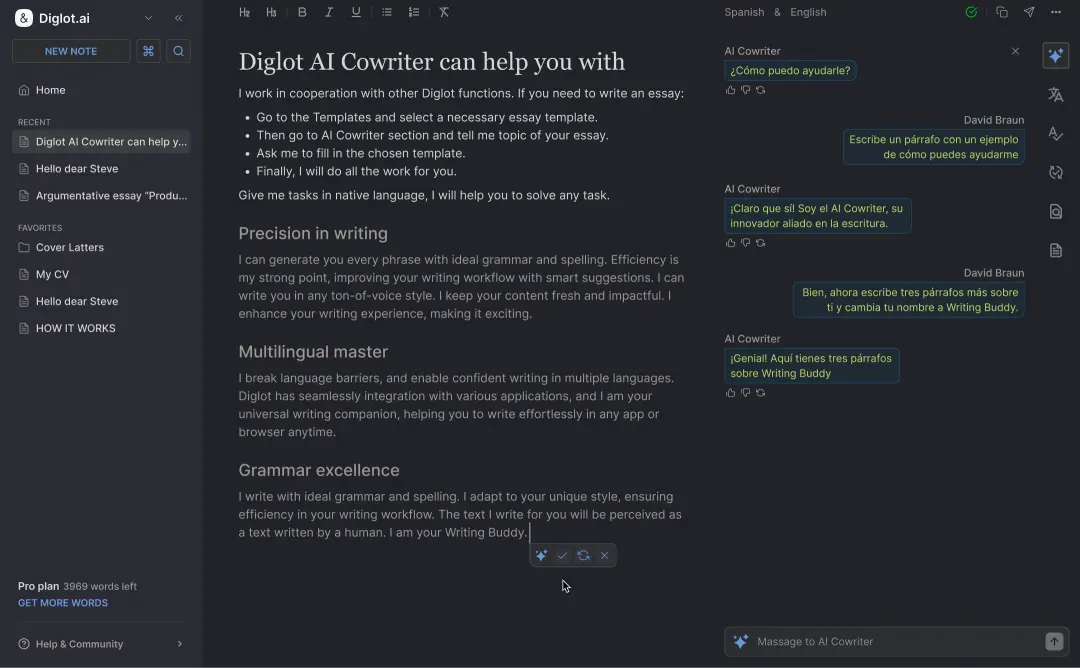
A grammar checker helps most when it does more than underline. Generic checkers will mark “I am agree” as wrong, but they will not tell you why your brain produced it — and without the why, you fix the sentence and keep the habit. Diglot’s grammar checker was built by and for people who write in English as a second language: it explains errors in your own language, and because it knows the Russian underneath, it can tell you “this is a calque of я согласен” rather than just “delete am”. That is the difference between correcting a document and retiring a pattern.
Runglish is not a defect to hide. It is a map of exactly where your two languages disagree — and once you can read the map, you get to decide, pattern by pattern, which side of each disagreement your writing lands on.