

In this article
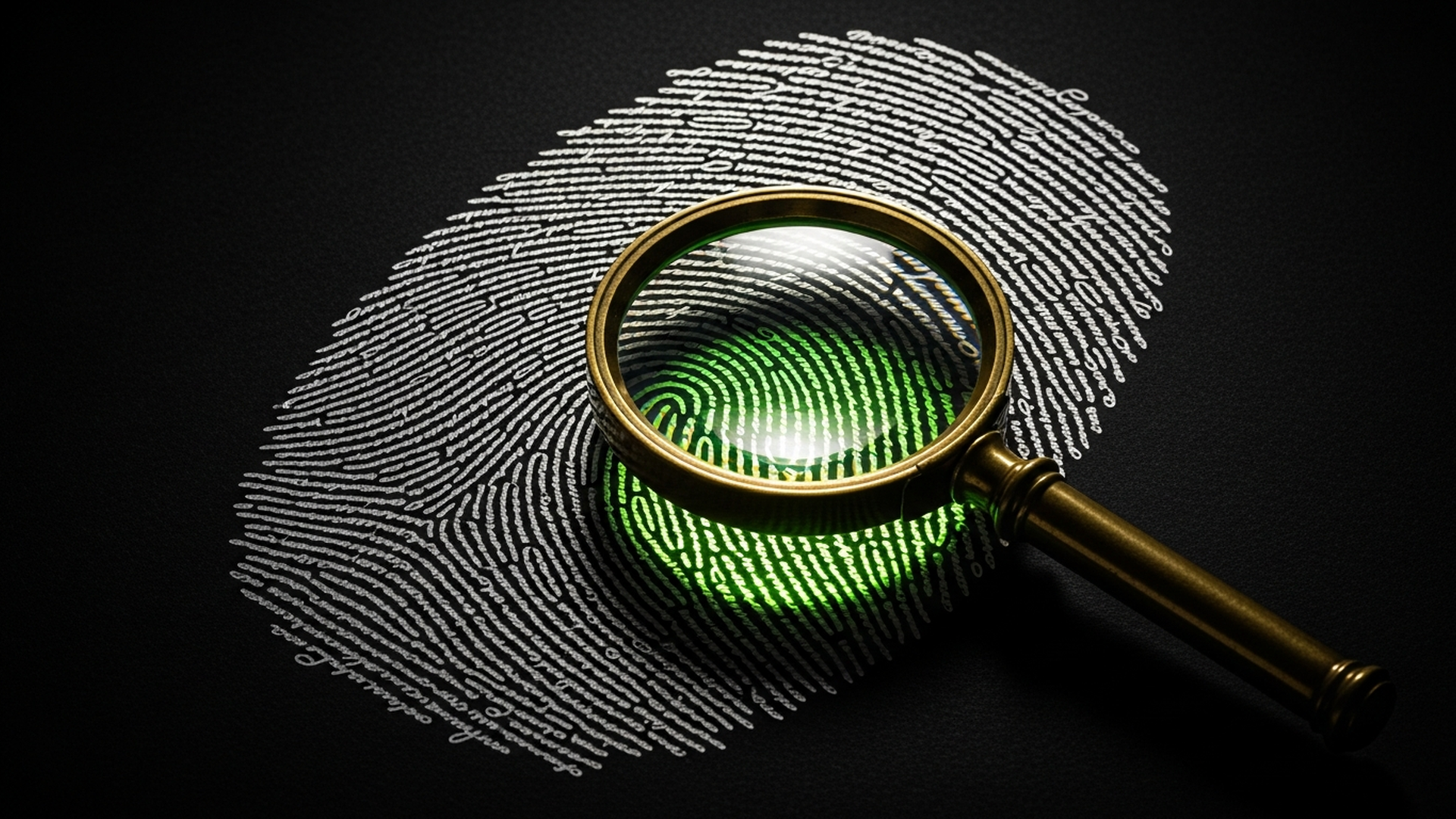
Stylometry is the statistical study of writing style: the idea that every writer leaves a measurable fingerprint in the small, unconscious choices they make — how often they write “upon” instead of “on”, how long their sentences run, where they put their commas. Because these habits are largely automatic, they are hard to fake and hard to suppress, which makes them useful for authorship attribution: given a disputed text and samples from candidate authors, stylometric analysis estimates who most likely wrote it. It has settled literary disputes and supported criminal investigations. And, in a crude, population-level form, it is the machinery inside every AI detector that has ever flagged an innocent student.
That last part is why this topic belongs on a blog for second-language writers. But let’s start with what stylometry actually is, because the real thing is more interesting than the version detectors use.
The fingerprint is in the boring words
When people imagine identifying an author by style, they usually think of the distinctive things: rare vocabulary, favorite metaphors, an unusual opinion. Stylometry mostly ignores all of that. The distinctive things are exactly what an imitator would copy and what an author would consciously vary. The signal lives somewhere less glamorous: in function words — the, of, by, upon, while, whilst — and in structural rhythms like sentence length distribution, punctuation habits, and how often clauses get stacked before the main verb.
Function words are powerful evidence for two reasons. First, they are frequent, so even a short text gives you a usable sample. Second, nobody chooses them deliberately. You do not sit down and decide your rate of “of” per thousand words. It emerges from how your syntax is wired, and it stays remarkably stable across topics. You can write about football or philosophy and your function-word profile barely moves.
Linguists have names for the thing being measured. Your idiolect is your personal variety of a language — the sum of every habit, preference and quirk that makes your usage yours, shaped by where you grew up, what you read, and (for those of us writing in a second language) which first language sits underneath. The measurable, quantified shadow of an idiolect in text is sometimes called a writeprint, by analogy with a fingerprint. Neither term means your style is unique in some cosmic sense. It means your habits are consistent enough, across enough dimensions at once, that they can distinguish you from a specific set of other candidates.
The Federalist Papers: stylometry’s founding case
The demonstration that made stylometry famous involves twelve essays from 1787–88. The Federalist Papers were published under the shared pseudonym “Publius” by Alexander Hamilton, James Madison and John Jay. For most of the essays, authorship was later established. But twelve remained disputed between Hamilton and Madison for over 160 years — both men had claimed them, and historians argued in circles.
In the early 1960s, statisticians Frederick Mosteller and David Wallace attacked the problem with function words. Hamilton and Madison wrote in nearly identical high-Federalist prose on identical topics, so content was useless. But their small-word habits diverged: Hamilton used “while”, Madison used “whilst”; their rates of “upon” and “enough” differed sharply. Running the numbers across the disputed essays, Mosteller and Wallace attributed all twelve to Madison — a conclusion that matched the drift of historical scholarship and has held up since. The lesson stuck: two authors who sound the same to a human reader can be cleanly separated by words no reader consciously notices.
Forensic linguistics: when style becomes evidence
Stylometry’s applied sibling is forensic linguistics — linguistic analysis used in legal contexts. Its most famous case is the Unabomber. In 1995, the man behind a seventeen-year bombing campaign demanded that newspapers publish his 35,000-word manifesto, “Industrial Society and Its Future”. FBI analysis of the manifesto’s language, led by profiler James Fitzgerald, suggested a specific kind of author. When the text was published, David Kaczynski recognized his brother Ted’s phrasing and ideas, and comparison between the manifesto and Ted Kaczynski’s earlier letters and essays became part of the evidence supporting the search warrant. The case is often cited as the moment forensic authorship analysis entered mainstream legal practice.
A gentler example: in 2013, after an anonymous tip reached a newspaper, a machine-assisted stylometric comparison indicated that “The Cuckoo’s Calling”, a debut crime novel by unknown author Robert Galbraith, closely matched the style of J.K. Rowling. Confronted with the analysis, Rowling confirmed the pen name within days.
Notice what both cases have in common: stylometry alone did not close either of them. It narrowed the field, corroborated a suspicion, justified a closer look. The confession, the warrant, the documents behind the pen name — the decisive evidence was always something more direct. Serious practitioners of authorship attribution are explicit about this: style analysis produces likelihoods over a defined set of candidates, not certainties about the world. Keep that in mind for the next section.
AI detectors are crude stylometry, and that is the problem
Here is the bridge to the present. An AI detector is doing something structurally similar to what Mosteller and Wallace did — measuring statistical properties of text and asking which population it resembles. But there are two critical downgrades.
First, classical stylometry compares a text against specific candidate authors with known writing samples. A detector compares your text against two enormous, fuzzy populations: “human writing in general” and “machine writing in general”. It has never seen your writing. It knows nothing about your idiolect. It can only ask whether your text looks like the average of one pile or the other, using signals like perplexity — roughly, how predictable your word choices are to a language model — and burstiness, the variation in your sentence rhythms.
Second, the question itself is harder. “Which of these two men wrote this?” is a well-posed problem with a closed answer set. “Did any human write this?” is an open-ended classification where the two populations overlap heavily — because modern AI models were trained to imitate human writing, and because plenty of humans naturally write in regular, predictable, low-surprise prose.
Who writes in regular, predictable, low-surprise prose? Disproportionately, people writing in their second language. English is my second language, and I know exactly how this happens: you build sentences from constructions you are certain of, you reuse phrasing you have seen validated, you keep sentence structures consistent because experimentation is where errors live. The result is careful, uniform text — which is precisely the statistical profile a detector reads as machine-like. A Stanford study (Liang et al., published in Patterns, 2023) found AI detectors falsely flagged 61% of TOEFL essays written by non-native English speakers. That is not a bug in one product; it is the predictable failure mode of population-level stylometry applied to writers whose population was underrepresented when the thresholds were set.
So when a detector flags your essay, it is not detecting AI. It is detecting distance from a statistical picture of “typical human writing” — a picture you were never fully inside to begin with. If that flag has already landed on you, we have a practical guide for what to do when Copyleaks flags human writing as AI, and the reasoning generalizes to every detector.
Your idiolect is worth keeping
There is a quieter cost in all this, separate from false accusations. If your writing has a fingerprint, then heavy AI rewriting is a fingerprint remover.
Run a paragraph through an AI “improve my writing” pass and look closely at what changes. It is rarely just the grammar. Sentence rhythms get regularized toward the model’s preferred cadence. Your slightly-off-but-yours phrasings become the standard collocation. Function-word habits, the deepest layer of the writeprint, drift toward the model’s defaults. Do this to every paragraph, every day, and the text that comes out is fluent, correct, and stylometrically not really yours anymore. Researchers studying clumsy machine paraphrasing have documented the extreme end of this: in 2021, Guillaume Cabanac and colleagues found “tortured phrases” in published papers (“counterfeit consciousness” where “artificial intelligence” should be), the debris of style-mangling tools. Everyday AI polishing is subtler, but it sands in the same direction: toward the average.
For second-language writers this creates a genuine dilemma, because we need language help more than most. The distinction worth drawing is between tools that fix your text and tools that grow your ability. This is the thinking behind Diglot’s weave method — mixing your native language into English text so you acquire the language while writing, instead of outsourcing the writing. Your errors get corrected; your rhythm, your choices, your idiolect stay in the text. A related habit helps day to day: before accepting a rewrite, check whether the “improved” version still sounds like a person. Our sounds-translated checker flags phrasing that reads like it went through a machine.
Style guesses; process proves
Now put the two halves together. Stylometry — even done properly, by experts, with named candidates and adequate samples — produces probabilistic opinions. Its serious practitioners hedge accordingly, and courts treat it as one strand of evidence among many. AI detection is stylometry with the safeguards removed: no candidate set, no writing samples from you, no expert weighing the result, just a percentage on a screen that an overworked instructor may read as a verdict. Building high-stakes decisions on that is like convicting on the Unabomber manifesto without ever finding the cabin, the typewriter, or the brother who recognized the prose.
The alternative is to change the kind of evidence entirely. Style-based analysis asks: does this text look like you? Process-based evidence asks: did we watch this text come into existence? Drafts, version history, revision timelines — these do not estimate authorship from statistical residue; they document it. Diglot’s editor records your writing process as an append-only, cryptographically signed chain of events while you work, and can produce an Authorship Certificate — tamper-evident documentation of how your document was actually written: the sessions, the revisions, the human-scale accumulation of a real draft. No probability, no population averages, no assumptions about what your English “should” look like.
That distinction matters most for exactly the writers stylometry treats worst. If your idiolect sits far from the statistical center of English — because English is your second, third, or fourth language — you will always score strangely on population-level style tests, and no amount of writing “more naturally” reliably fixes that. The constant low-level fear of the next flag, the thing we call flagxiety, pushes people to deliberately damage their own writing to seem more human. The better answer is to stop playing the guessing game altogether: keep your fingerprint, and carry proof of process instead.
Your writing style took years to build — first language, every book you read, every sentence you rewrote. It identifies you, in the way stylometry has demonstrated for more than a century. It deserves better than being erased by a rewrite button or misjudged by a bulk classifier. Keep it, and keep the receipts.