


In this article
What transition words actually do
Transition words and linking phrases are the connective tissue of academic English. They signal the logical relationship between ideas — this adds to that, this contrasts with that, this caused that — and turn a list of separate sentences into an argument a reader can follow. As university writing centers put it, they are signs that tell readers how to think about your ideas.
For non-native writers the trouble runs in two opposite directions, and this guide fixes both: a function-organized toolbox of idiomatic connectors, the punctuation rules that trip up even advanced learners, and the overuse problem that makes prose feel mechanical.
The two ESL failure modes
Too few transitions make writing feel choppy and jumpy — each sentence a separate island. But the opposite is just as common: a reflex of stacking "moreover" and "furthermore" on every sentence, which reads as stilted and repetitive. The goal is not maximum connectors. It is the right connector where the logic actually shifts.
The transition toolbox, by function
Choose your connector by the relationship you want to signal. The lists below are cross-checked against the UNC Writing Center, the UW-Madison Writing Center, and the Manchester Academic Phrasebank.
| Function | Idiomatic academic connectors |
|---|---|
| Adding | in addition, furthermore, moreover, additionally, also, besides |
| Contrasting | however, nevertheless, nonetheless, on the other hand, in contrast, conversely, whereas, yet |
| Cause and effect | therefore, consequently, as a result, hence, thus, accordingly, for this reason |
| Sequence | first, second, next, then, subsequently, afterwards, finally |
| Example | for example, for instance, to illustrate, namely, specifically, in particular |
| Comparison | similarly, likewise, in the same way, by the same token |
| Clarification | in other words, that is, to put it another way |
| Conclusion | in conclusion, to conclude, in summary, overall, on the whole, to sum up |
| Concession | nevertheless, nonetheless, even so, that said, admittedly, granted |
One caution: the concession words above are conjunctive adverbs, which take the semicolon-before, comma-after punctuation in the next section. The subordinators although, though, and even though, and the prepositions despite and in spite of, also signal concession, but they join clauses directly and are not punctuated that way ("Although the sample was small, the result held.").
For moving between paragraphs and sections, the Phrasebank also offers signposts: "Turning now to...", "Having defined X, I will now discuss...", "As discussed above...", "In summary, it has been shown that...".
The punctuation rules every ESL writer needs
This is where advanced writers slip. Conjunctive adverbs — however, therefore, moreover, thus, consequently, nevertheless — follow strict rules that differ from "but" and "and". The standard rule:
- Opening a sentence: comma after. "Therefore, the animals were re-examined."
- Joining two independent clauses: semicolon before, comma after. "The game was almost lost; however, our team scored."
- The comma splice (wrong): "The game was almost lost, however our team scored." A single comma cannot join two complete sentences. Fix it with a semicolon or a period.
The reason it differs from "but": coordinating conjunctions (but, and, so) join clauses right after a comma, while conjunctive adverbs (however, therefore) must be preceded by a period or semicolon. Treating "however" like "but" is the single most common transition error. For related issues, see punctuation differences for non-native writers.
Common ESL mistakes
- Overusing moreover and furthermore. They are intensifiers, not default connectors. For plain addition, use "in addition" or "also", or delete the connector.
- "In the other hand." The idiom is "on the other hand". The preposition is "on".
- "In conclusion" everywhere. Fine once, at the actual end. Vary with "overall" or "to sum up".
- Starting every sentence with the same connector. Vary the word and the placement.
- Over-signposting. If the reader can already see the link, the connector is clutter.
Before and after
Choppy: "The experiment used a small sample. The results were not significant. The findings suggest a trend. More research is needed."
Cohesive: "The experiment used a small sample; consequently, the results were not significant. Nevertheless, the findings suggest a trend worth investigating. For this reason, more research is needed."
Notice the connectors were added where the logic shifts — cause, contrast, cause — not on every sentence. For the opposite problem, sentences that break apart, see sentence fragments and run-ons.
How Diglot helps
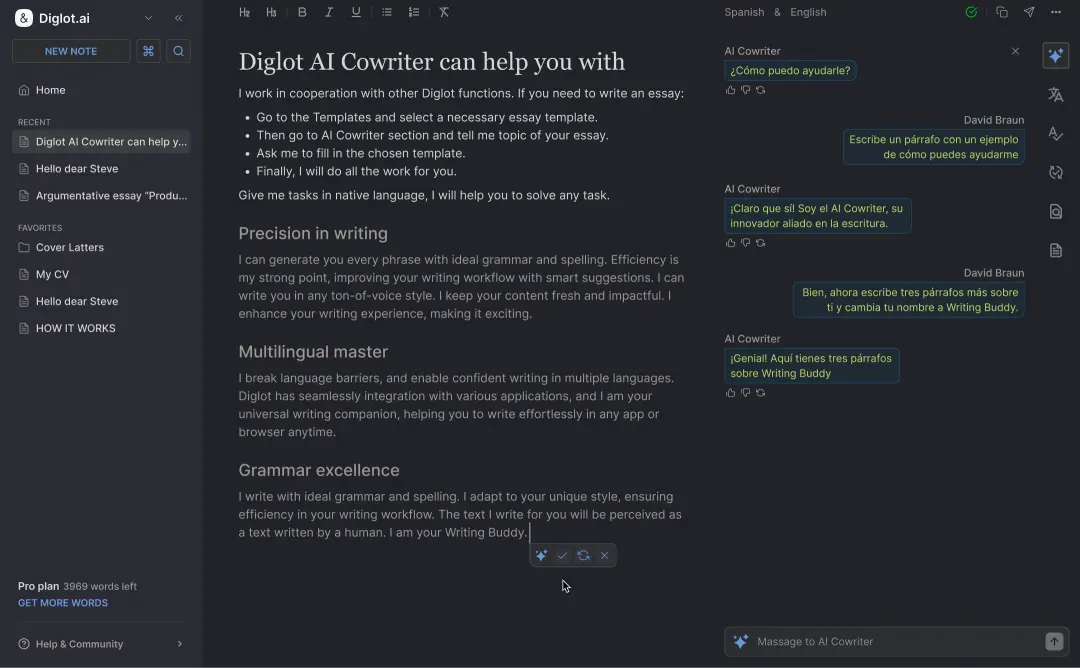
Cohesion is a skill you build, and Diglot helps you build it as you write.
- Catch the punctuation errors. The grammar checker flags comma splices with "however" and the other conjunctive-adverb slips automatically.
- Fix overused connectors. The paraphrasing tool rewrites a sentence that leans on "moreover" into something cleaner, and helps smooth choppy prose.
- Build flow as you draft. The AI writing assistant suggests where a logical link actually helps. Pair this with hedging in academic writing, a related cohesion skill.
- Built for students. Explore the writing tool for students.
Good academic writing is not stuffed with connectors — it places the right one exactly where the argument turns. Learn the toolbox by function, punctuate your conjunctive adverbs correctly, and use them sparingly, and your prose will read as a single, flowing argument instead of a list.