Diglot vs ChatGPT
The ChatGPT alternative for people who think in another language first: draft, translate, rewrite and check grammar in one editor.
- You are submitting a paper to a journal or university where hallucinated citations can cause rejection or retraction
- You write in English as a second language and want to keep your own scholarly voice instead of generic ChatGPT phrasing
- You want Claim Confidence checked against your uploaded PDFs plus a free Authorship Certificate
No credit card required · Your text opens in the editor after sign-up
When Diglot is the better pick over ChatGPT
ChatGPT generates prose inside a chat thread and guesses citations from memory; Diglot is an L1→EN academic document editor with verified DOIs, Claim Confidence against your PDFs, and a free ed25519 Authorship Certificate.
One window instead of five tabs and five bills
Before: five tabs
- Jenni AIAutocomplete and citations, but no help with a second language.~$20Unlimited, monthly
- DeepL ProTranslates outside your document, so citations and tone are lost.~$8.74from, monthly
- QuillBot PremiumRewrites one paragraph at a time in a separate tab.$19.95monthly
- Grammarly ProFixes the sentence without naming the first-language habit behind it.~$12per month, billed yearly
- ChatGPT PlusRewrites in its own voice and can invent references.$20monthly
If you pay for all five~$81/ month
After: one Diglot document
- Drafting, autocomplete and citations
- Translation inside the document
- Rewrites in five tones
- Grammar that names your first-language habits
- Cowriter with 30+ skills, every edit waiting for you
- Your PDFs, your glossary and a free Authorship Certificate
Publicly listed prices: Jenni AI verified 2026-07-18; DeepL, QuillBot and Grammarly verified 2026-04-13; ChatGPT Plus as listed by OpenAI. Prices change, so check each vendor before you buy.
Try a skill on a real paragraph
Your draft
Many researches shows that students which use social media more than three hours per day have lower grades. In our opinion this is because the constant notifications make difficult to concentrate, so the information is not stay in the memory.
We propose to migrate our reporting to the new platform in Q1. This will reduce costs a lot and the team will be more productive, because the old system is very slow and nobody likes it.
We are very sorry for the delay, it was not our fault but the supplier one. We will try to send you the goods until Friday, please be patient with us and don’t cancel the order.
Cowriter /formalize · Fluent AI
Many studies show that students who use social media for more than three hours per day have lower grades. We believe this is because constant notifications make it difficult to concentrate, so information does not stay in memory.
Example output written for this page to show the difference between AI tiers; real results depend on your text. Fluent AI is on Free, Native AI on Pro.
Every citation leads back to a real page and a real DOI
Your paragraph
The Transformer replaced recurrence with attention alone , and pre-trained encoders such as BERT carried the idea to language understanding . Attention mechanisms first improved neural machine translation .
References
- Vaswani, A., Shazeer, N., Parmar, N., Uszkoreit, J., Jones, L., Gomez, A. N., Kaiser, Ł., & Polosukhin, I. (2017). Attention is all you need. arXiv. https://doi.org/10.48550/arXiv.1706.03762
- Devlin, J., Chang, M.-W., Lee, K., & Toutanova, K. (2019). BERT: Pre-training of deep bidirectional transformers for language understanding. Proceedings of NAACL-HLT. https://doi.org/10.18653/v1/N19-1423
Your library · p. 1, abstract
We propose a new simple network architecture, the Transformer, based solely on attention mechanisms, dispensing with recurrence and convolutions entirely.
DOI resolves · 10.48550/arXiv.1706.03762
Example built from real papers and DOIs. In the editor, /library answers from the PDFs you upload, /check-sources looks each DOI up, and /find-source suggests papers for an uncited claim.
The slips your first language puts in your English
Thank you for your comprehensionThank you for your understanding
“Comprensión” is a false friend: in English it is “understanding”.
Actually, we use the old systemCurrently, we use the old system
“Actualmente” means “currently”, not “actually”.
I assisted to the conferenceI attended the conference
“Asistir a” means to attend; “assist” means to help.
temperature of samplethe temperature of the sample
Your language has no articles; English needs “the” here.
We discussed about the resultsWe discussed the results
“Обсуждать” takes a preposition; “discuss” does not.
It depends of many factorsIt depends on many factors
A calque of “зависит от”: English uses “depend on”.
Joined Sony 2020I joined Sony in 2020
Your language drops the subject; English needs it.
Yesterday I go to the clientYesterday I went to the client
The verb does not change for tense in Mandarin; English marks the past.
Sorry to bother you, if possible maybe could you send itCould you send it?
Layered politeness reads as unsure in English business writing.
He is having two carsHe has two cars
“Have” for ownership does not take the -ing form.
I am agree with the planI agree with the plan
“Agree” is already a verb; it needs no “am”.
Please do the needfulPlease take care of it
Common in Indian English, unclear to readers elsewhere.
I work here since three yearsI have worked here for three years
“Seit / depuis” becomes “for” with the present perfect.
We have discussed it yesterdayWe discussed it yesterday
A finished time like “yesterday” takes the past simple.
We will eventually postpone the launchWe may postpone the launch
“Eventuell / éventuellement” means “possibly”, not “in the end”.
Typical slips for each language group. Diglot flags them in your own draft and explains the habit behind each one.
A signed record of how the document was written
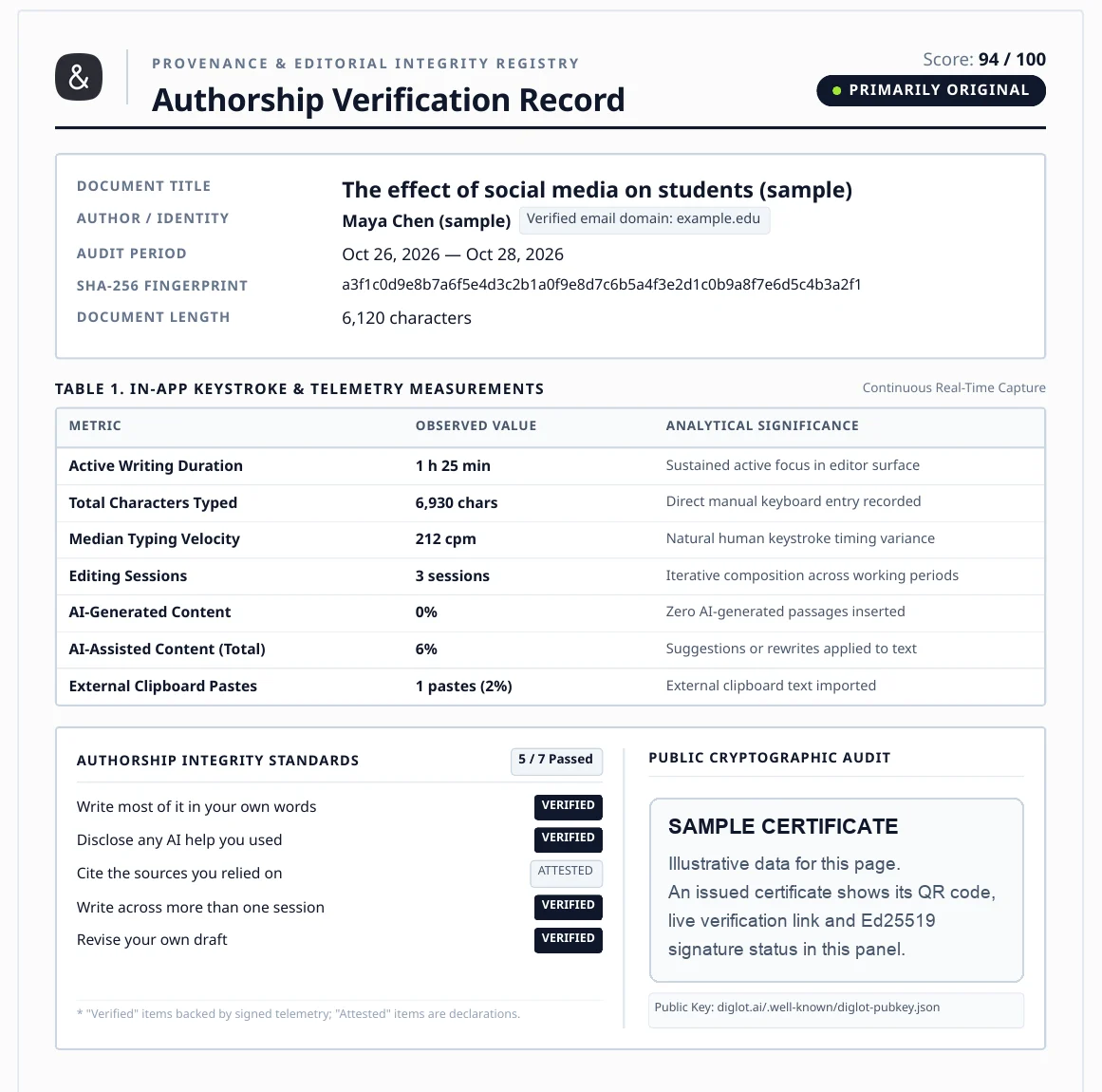
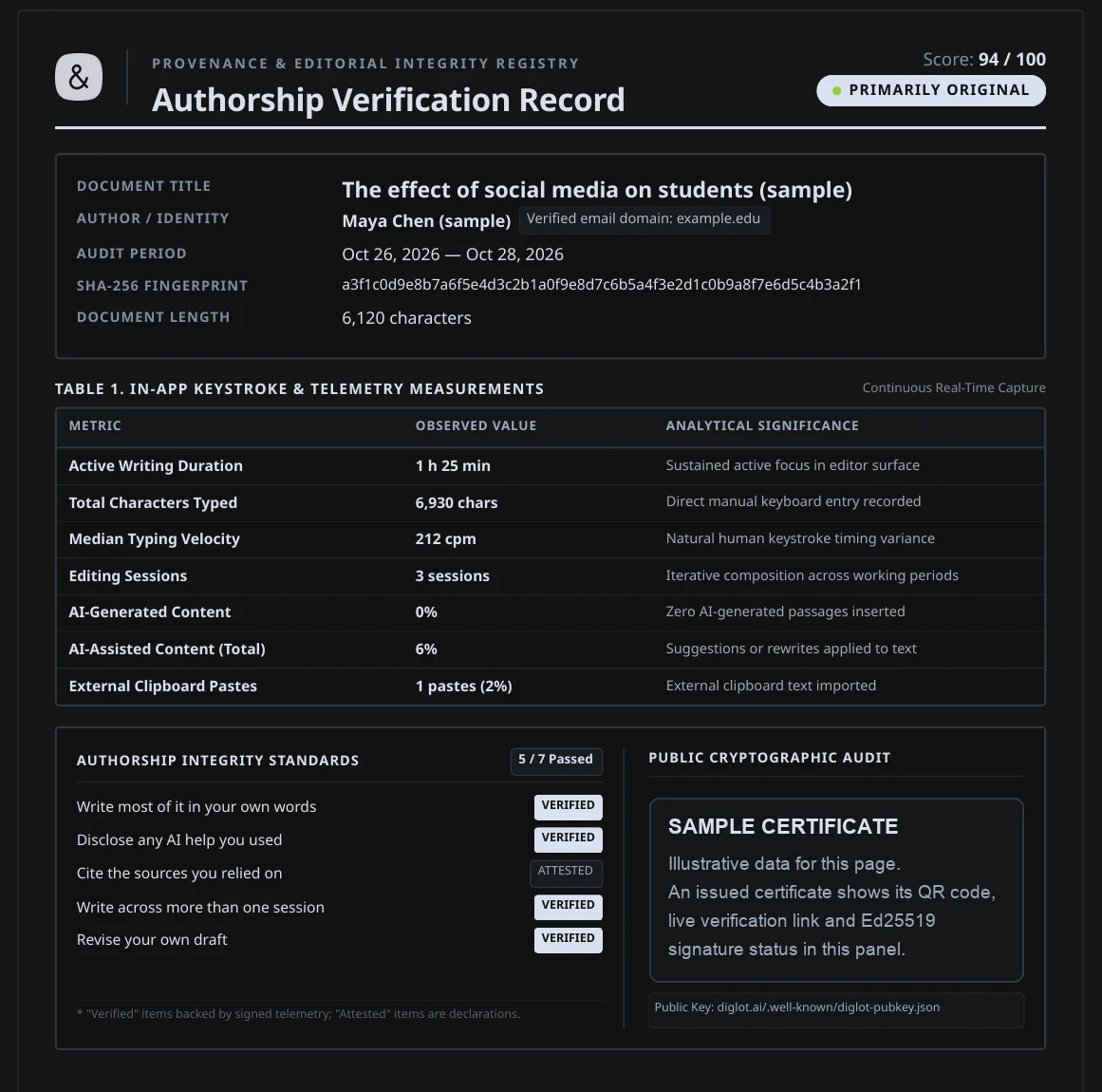
The certificate PDF Diglot issues, filled with sample data. A real one carries a QR code and a live verification link.
- Session 1 · Outline and notes22 min
- Session 2 · Drafting, two languages, 4 citations48 min
- Session 3 · Cowriter /formalize and grammar review15 min
- Certificate exported with a verification linkfree
- Example timeline. Writing the whole document in Diglot is what gives the record its weight: a pasted paragraph shows up as a paste.
Feature-by-feature comparison
| Feature | ChatGPT | Diglot |
|---|---|---|
| Verified scholarly citations (anti-hallucination) | Risk of Made Up / Mixed Up DOIs unless manually verified against external databases | 9 open scholarly indexes (OpenAlex, Crossref, PubMed, arXiv) + 10,852 CSL styles + free Fake Citation Checker |
| 9-Point Pre-Submission Audit (Claim Confidence, Citation Gaps, Peer Review) | ✗ | Built into the editor (previewable free on /tools/essay-grader) |
| L1-aware ESL editing without erasing your voice | Rewrites whole paragraphs in generic AI register | Inline diffs, L1 transfer-pattern explanations, and personal vocabulary learn-back |
| Authorship Certificate (writing process record) | ✗ | Included free and unlimited on every plan |
| Plagiarism check | ✗ | ✗ |
Pricing
One connected writing workspace instead of paying for 4 separate subscriptions.
QuillBot ($19.95) + DeepL ($8.74) + Grammarly ($12) + Jenni ($20) = $60.69 – $81 / mo
From $15.83 / mo Save 76% ($62/mo)
ChatGPT
Single-purpose utility- Free $0 rate-limited
- Plus $20 / month
- Verified scholarly citations Risk of Made Up / Mixed Up DOIs unless manually verified against external databases
- 9-Point Pre-Submission Audit — not included
- L1-aware ESL editing without erasing your voice Rewrites whole paragraphs in generic AI register
- Authorship Certificate — not included
- Plagiarism check — not included
Diglot
Complete Writing Workspace- Free$0 no card needed
- 500 words / day paraphrase
- 3,000 words / mo translation
- 10 Cowriter messages / day
- 1 Deep Research report / mo
- Authorship Certificate included
- Save 76% · Most PopularSpark$15.83 / mo, billed $190/yr $19 / month
- 30,000 words paraphrase & rewrite / mo
- 50,000 words translation · Smart AI
- 1,000 Cowriter msgs (35 skills)
- 5 Deep Research reports / mo
- 10,852 citation styles & PDF upload
- Native AI TierPro$28.33 / mo, billed $340/yr $34 / month
- Native-tier AI (publication quality)
- 50,000 words paraphrase / mo
- 100,000 words translation / mo
- 2,000 Cowriter msgs · cross-session recall
- 30 Deep Research reports / mo
Flexible on-demand word packs — no forced tier upgrades
Working on a thesis deadline or heavy paper submission? Add extra volume on demand without changing subscription tiers: +40,000 word packs ($15) and Deep Research packs are available anytime directly inside your workspace.
Pricing verified 2026-11-21. Public pricing changes — confirm on each vendor's site before purchase.
Where ChatGPT ends and Diglot begins
The default general-purpose AI chatbot — great for brainstorming, risky for academic citations, ESL voice, and writing-process transparency.
ChatGPT is the fastest way to brainstorm an outline, debug code, or explore an unfamiliar concept. For academic papers submitted to journals or universities in 2026, however, a general chat box creates three serious problems: hallucinated citations that trigger COPE retractions, homogenized prose that raises AI-detector flags on non-native English writers, and zero writing-process record. Diglot is a purpose-built academic editor that keeps your meaning, verifies every source against nine scholarly indexes, runs a 9-Point Pre-Submission Audit, and records a free Authorship Certificate as you write.
What ChatGPT sells
- General-purpose conversational AI for brainstorming, coding, and drafting
- Deep Research web synthesis reports on higher tiers
- File uploads, voice mode, and broad everyday productivity
Why ChatGPT wins
- Unmatched versatility across non-writing tasks (code, math, brainstorming)
- Huge ecosystem and familiar chat interface
- Strong early-stage exploration via Deep Research
ChatGPT wins when
- You are brainstorming ideas, debugging Python/R scripts, or solving general tasks outside academic writing
- You want an all-purpose conversational assistant rather than a manuscript editor
Deep dive: general chat box vs submission-ready academic editor
Copy-pasting paragraphs between a document and ChatGPT breaks three things at once: your citations lose provenance, your phrasing picks up mechanical AI clichés, and your document loses its revision history.
Diglot replaces that copy-paste loop with one editor where bilingual L1→EN scaffolding, nine scholarly citation indexes, a 9-Point Pre-Submission Audit, and a free Authorship Certificate work on the same document.
Frequently asked questions
Why does ChatGPT still produce fake or mismatched academic citations?
ChatGPT predicts plausible text patterns rather than pulling structured records from a bibliographic database. Even with web search enabled, it can mix up publication years, swap author names, or cite a real paper for a claim it never made. Always verify DOIs against Crossref and check Claim Confidence against the actual PDF.
Is using Diglot allowed under 2026 journal and university AI policies?
Major publishers (Nature, Elsevier, Springer Nature) and COPE permit assistive language editing while prohibiting AI authorship and fabricated references. Diglot keeps you in control with inline diffs, verified scholarly sources, and a transparent Authorship Certificate.
Sound like you? Try Diglot free.
If «you are submitting a paper to a journal or university where hallucinated citations can cause rejection or retraction» describes your work, the free tier covers daily writing — no card.
No credit card required
Where to go next
ChatGPT is one tool against Diglot. The picks below frame the decision against similar tools, your real workflow, and the broader category.
