Diglot vs Elicit
The Elicit alternative for people who think in another language first: draft, translate, rewrite and check grammar in one editor.
- You need grounded literature synthesis for a thesis chapter or paper without enterprise extraction pricing
- Your true bottleneck happens after extraction: writing cohesive English discussions from L1 notes
- You want 10,852 CSL styles, paraphrase options, and L1 grammar guidance in one tab
- You need an independent Authorship Certificate attached to your manuscript
No credit card required · Your text opens in the editor after sign-up
When Diglot is the better pick over Elicit
Elicit is built for high-volume evidence tables at $49–$75/mo; Diglot brings cited multi-index research into the actual bilingual manuscript editor at $15.83/mo annual, adding L1 coaching and Authorship Certificates.
One window instead of five tabs and five bills
Before: five tabs
- Jenni AIAutocomplete and citations, but no help with a second language.~$20Unlimited, monthly
- DeepL ProTranslates outside your document, so citations and tone are lost.~$8.74from, monthly
- QuillBot PremiumRewrites one paragraph at a time in a separate tab.$19.95monthly
- Grammarly ProFixes the sentence without naming the first-language habit behind it.~$12per month, billed yearly
- ChatGPT PlusRewrites in its own voice and can invent references.$20monthly
If you pay for all five~$81/ month
After: one Diglot document
- Drafting, autocomplete and citations
- Translation inside the document
- Rewrites in five tones
- Grammar that names your first-language habits
- Cowriter with 30+ skills, every edit waiting for you
- Your PDFs, your glossary and a free Authorship Certificate
Publicly listed prices: Jenni AI verified 2026-07-18; DeepL, QuillBot and Grammarly verified 2026-04-13; ChatGPT Plus as listed by OpenAI. Prices change, so check each vendor before you buy.
Try a skill on a real paragraph
Your draft
Many researches shows that students which use social media more than three hours per day have lower grades. In our opinion this is because the constant notifications make difficult to concentrate, so the information is not stay in the memory.
We propose to migrate our reporting to the new platform in Q1. This will reduce costs a lot and the team will be more productive, because the old system is very slow and nobody likes it.
We are very sorry for the delay, it was not our fault but the supplier one. We will try to send you the goods until Friday, please be patient with us and don’t cancel the order.
Cowriter /formalize · Fluent AI
Many studies show that students who use social media for more than three hours per day have lower grades. We believe this is because constant notifications make it difficult to concentrate, so information does not stay in memory.
Example output written for this page to show the difference between AI tiers; real results depend on your text. Fluent AI is on Free, Native AI on Pro.
Every citation leads back to a real page and a real DOI
Your paragraph
The Transformer replaced recurrence with attention alone , and pre-trained encoders such as BERT carried the idea to language understanding . Attention mechanisms first improved neural machine translation .
References
- Vaswani, A., Shazeer, N., Parmar, N., Uszkoreit, J., Jones, L., Gomez, A. N., Kaiser, Ł., & Polosukhin, I. (2017). Attention is all you need. arXiv. https://doi.org/10.48550/arXiv.1706.03762
- Devlin, J., Chang, M.-W., Lee, K., & Toutanova, K. (2019). BERT: Pre-training of deep bidirectional transformers for language understanding. Proceedings of NAACL-HLT. https://doi.org/10.18653/v1/N19-1423
Your library · p. 1, abstract
We propose a new simple network architecture, the Transformer, based solely on attention mechanisms, dispensing with recurrence and convolutions entirely.
DOI resolves · 10.48550/arXiv.1706.03762
Example built from real papers and DOIs. In the editor, /library answers from the PDFs you upload, /check-sources looks each DOI up, and /find-source suggests papers for an uncited claim.
The slips your first language puts in your English
Thank you for your comprehensionThank you for your understanding
“Comprensión” is a false friend: in English it is “understanding”.
Actually, we use the old systemCurrently, we use the old system
“Actualmente” means “currently”, not “actually”.
I assisted to the conferenceI attended the conference
“Asistir a” means to attend; “assist” means to help.
temperature of samplethe temperature of the sample
Your language has no articles; English needs “the” here.
We discussed about the resultsWe discussed the results
“Обсуждать” takes a preposition; “discuss” does not.
It depends of many factorsIt depends on many factors
A calque of “зависит от”: English uses “depend on”.
Joined Sony 2020I joined Sony in 2020
Your language drops the subject; English needs it.
Yesterday I go to the clientYesterday I went to the client
The verb does not change for tense in Mandarin; English marks the past.
Sorry to bother you, if possible maybe could you send itCould you send it?
Layered politeness reads as unsure in English business writing.
He is having two carsHe has two cars
“Have” for ownership does not take the -ing form.
I am agree with the planI agree with the plan
“Agree” is already a verb; it needs no “am”.
Please do the needfulPlease take care of it
Common in Indian English, unclear to readers elsewhere.
I work here since three yearsI have worked here for three years
“Seit / depuis” becomes “for” with the present perfect.
We have discussed it yesterdayWe discussed it yesterday
A finished time like “yesterday” takes the past simple.
We will eventually postpone the launchWe may postpone the launch
“Eventuell / éventuellement” means “possibly”, not “in the end”.
Typical slips for each language group. Diglot flags them in your own draft and explains the habit behind each one.
A signed record of how the document was written
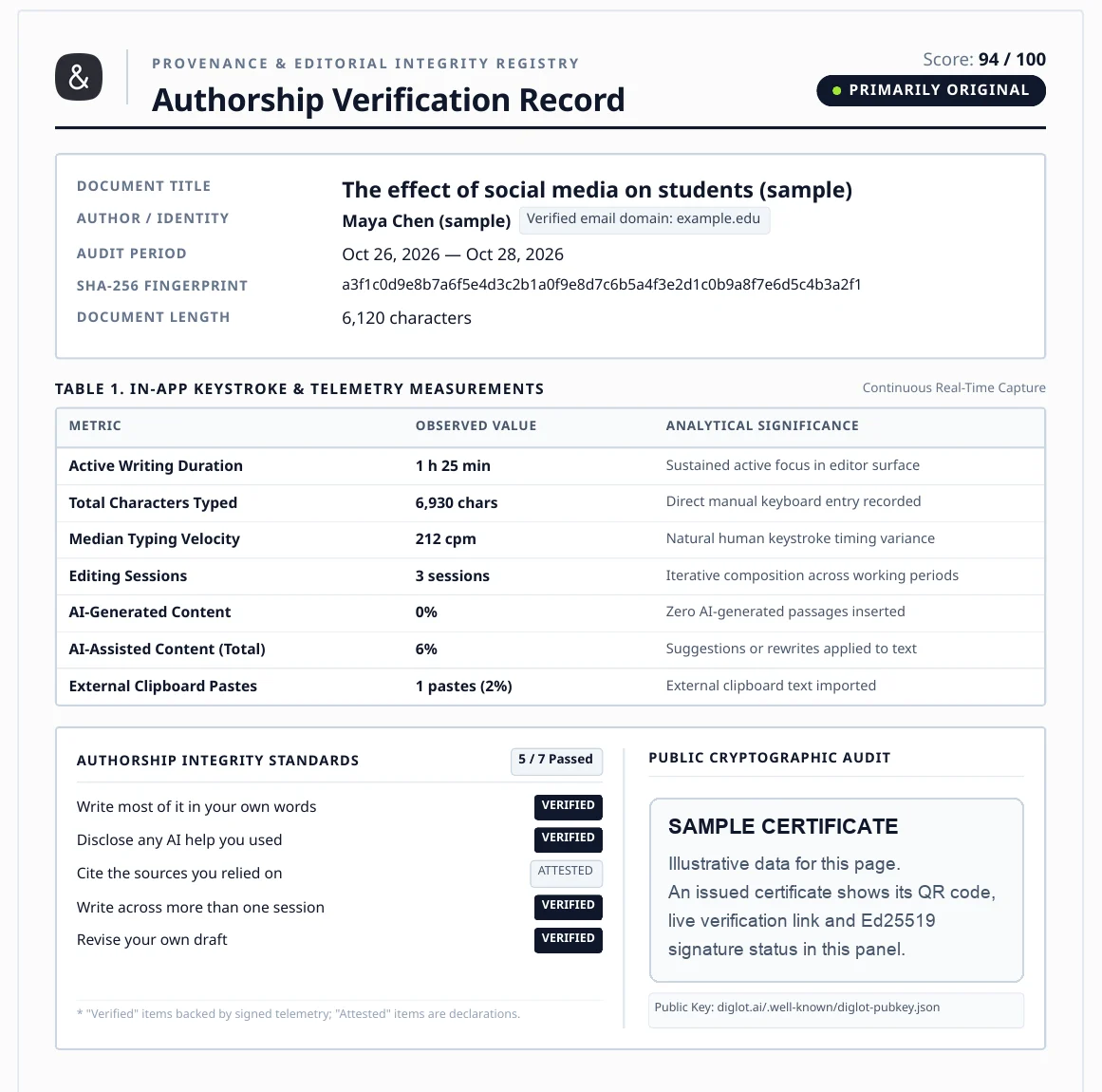
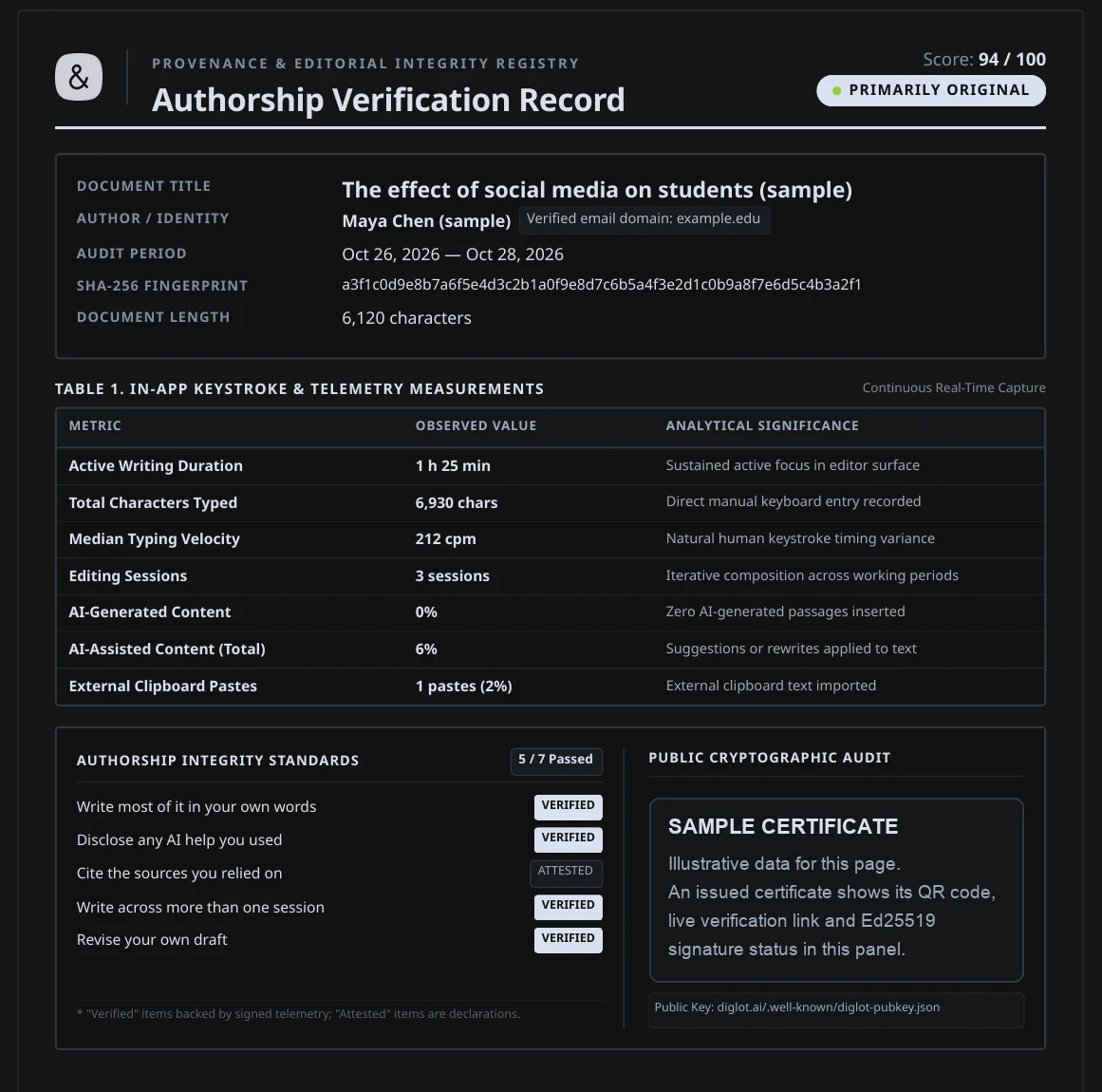
The certificate PDF Diglot issues, filled with sample data. A real one carries a QR code and a live verification link.
- Session 1 · Outline and notes22 min
- Session 2 · Drafting, two languages, 4 citations48 min
- Session 3 · Cowriter /formalize and grammar review15 min
- Certificate exported with a verification linkfree
- Example timeline. Writing the whole document in Diglot is what gives the record its weight: a pasted paragraph shows up as a paste.
Feature-by-feature comparison
| Feature | Elicit | Diglot |
|---|---|---|
| PRISMA-scale screening & multi-column CSV matrices Elicit is purpose-built for systematic evidence extraction at institutional scale. | Yes — up to 5,000 papers on Pro, 20 custom columns | ✗ |
| Cited Research Reports inside writing workspace | Yes — standalone Research Reports (up to 135 sources on Pro) | Yes — Deep Research (1–30/mo) feeding straight into bilingual editor |
| Entry Pro pricing (billed annually) | $49/user/mo annual ($75 monthly); Scale $229–$375/mo | Spark $15.83/mo annual ($19 monthly); Pro $28.33/mo ($34 monthly) |
| Bilingual drafting & native-language grammar feedback | ✗ | Yes — L1 transfer diagnostics + 3 register renderings inline |
| Authorship Certificate proving human composition | ✗ | Included on all plans |
Same task, both tools: turning 15 empirical findings into a Discussion
A Japanese postdoctoral researcher finishes screening cognitive intervention trials and must explain heterogeneous effect sizes clearly in a journal Discussion.
With Elicit
- Generate an Elicit summary table listing sample size, intervention length, and effect size.
- Export CSV columns and open Word to synthesize limitations in English.
- Write long Japanese-style topic-first sentences («As for older cohorts, dosage variance can be considered relevant»).
- Run third-party proofreading tools separately without capturing authorship metadata.
The downside: Paying $49–$75/mo yet still juggling CSV exports, awkward topic-prominent English structures, and unverified manuscript provenance.
With Diglot
- Pull key contradictory papers via Deep Research across OpenAlex and PubMed inside Diglot.
- Compare literal vs idiomatic English renderings from Japanese argument sketches side by side.
- Eliminate calqued phrasing and check hedging verbs while formatting citations in place.
- Export the polished Discussion backed by an unbroken Authorship Certificate.
The upside: Lower monthly cost for non-PRISMA authors, natural academic flow, and durable proof of human authorship.
Pricing
One connected writing workspace instead of paying for 4 separate subscriptions.
QuillBot ($19.95) + DeepL ($8.74) + Grammarly ($12) + Jenni ($20) = $60.69 – $81 / mo
From $15.83 / mo Save 76% ($62/mo)
Elicit
Single-purpose utility- Basic $0 unlimited search · capped Agent
- Pro $49 / mo annual ($75 monthly)
- Scale $229 / mo annual ($375 monthly)
- PRISMA-scale screening & multi-column CSV matrices Yes — up to 5,000 papers on Pro, 20 custom columns
- Cited Research Reports inside writing workspace Yes — standalone Research Reports (up to 135 sources on Pro)
- Entry Pro pricing $49/user/mo annual ($75 monthly); Scale $229–$375/mo
- Bilingual drafting & native-language grammar feedback — not included
- Authorship Certificate proving human composition — not included
Diglot
Complete Writing Workspace- Free$0 no card needed
- 500 words / day paraphrase
- 3,000 words / mo translation
- 10 Cowriter messages / day
- 1 Deep Research report / mo
- Authorship Certificate included
- Save 76% · Most PopularSpark$15.83 / mo, billed $190/yr $19 / month
- 30,000 words paraphrase & rewrite / mo
- 50,000 words translation · Smart AI
- 1,000 Cowriter msgs (35 skills)
- 5 Deep Research reports / mo
- 10,852 citation styles & PDF upload
- Native AI TierPro$28.33 / mo, billed $340/yr $34 / month
- Native-tier AI (publication quality)
- 50,000 words paraphrase / mo
- 100,000 words translation / mo
- 2,000 Cowriter msgs · cross-session recall
- 30 Deep Research reports / mo
Flexible on-demand word packs — no forced tier upgrades
Working on a thesis deadline or heavy paper submission? Add extra volume on demand without changing subscription tiers: +40,000 word packs ($15) and Deep Research packs are available anytime directly inside your workspace.
Pricing verified 2026-11-12. Public pricing changes — confirm on each vendor's site before purchase.
Where Elicit ends and Diglot begins
Systematic review automation platform scanning 138M+ papers into custom extraction columns, screening pipelines, and PRISMA workflows.
Elicit occupies a clear enterprise-grade niche: automating large-scale systematic reviews and evidence tables across 138M+ academic papers. Researchers define custom extraction columns — intervention dose, outcome metric, follow-up window — and screen up to 5,000 studies or run automated PRISMA pipelines. Nothing in Diglot attempts 5,000-paper spreadsheet screening. However, Elicit Pro costs $49/user/month billed annually ($75 monthly), and its workflow stops once your synthesis report or CSV matrix is generated. When non-native researchers must turn that extracted evidence into nuanced academic prose without spending $588/year just on extraction, Diglot covers cited synthesis plus bilingual composition and proof of human writing.
What Elicit sells
- Large-scale search across 138M+ peer-reviewed papers
- Custom extraction columns across up to 5,000 screened papers (Pro) or 40,000 (Enterprise)
- Structured Research Reports (up to 135 sources per report on Pro)
- Automated recurring literature Routines, Zotero sync, and API access
Why Elicit wins
- Unmatched structured extraction matrices for PRISMA and clinical meta-analyses
- High-volume screening scale trusted by epidemiology and policy groups
- Strong methodological filtering and transparent source-passage grounding
Elicit wins when
- You are running a formal systematic review or clinical meta-analysis of 500–5,000 papers
- Structured spreadsheet columns (sample size, CI, risk of bias) are the main deliverable
- An institutional lab grant covers the $588–$2,748/yr per-seat subscription
Deep dive: extraction matrices versus finishing the argument
Once a systematic review table is exported, the hardest writing begins: explaining *why* Study A’s null finding diverges from Study B’s subgroup effect, hedging certainty precisely with modals («may attenuate» vs «demonstrates»), and keeping long topic-comment sentences from reading like Japanese or Arabic calques.
At $49–$75/month, Elicit solves quantitative screening brilliantly yet leaves that compositional stage completely untouched. Diglot bridges the gap at less than a third of the price by pairing curated multi-index citation lookup with L1-aware revision and documented authorship.
Frequently asked questions
Is Diglot a systematic review tool like Elicit?
No — Elicit’s systematic screening over 5,000+ studies with 20 custom extraction columns is a specialized meta-analysis product we do not replicate. Diglot Deep Research is designed for focused literature reviews during active manuscript drafting, integrated with bilingual writing and citations.
Can I use Elicit and Diglot together?
Yes, cleanly. Many meta-analysis authors use Elicit Basic or an institutional seat to screen included studies, then switch into Diglot to compose the Discussion and Background sections in academic English with L1 grammar support and an Authorship Certificate.
Why is Elicit Pro so much more expensive than Diglot Spark?
Elicit’s Pro plan at $49/mo annual ($75 monthly) prices for heavy institutional data-extraction compute — scanning thousands of full-text PDFs into structured matrices. Diglot Spark ($15.83/mo annual, $19 monthly) optimizes the everyday author workflow: research synthesis, bilingual drafting, citations, and authorship verification.
Does Elicit check grammar or offer bilingual support?
No — Elicit is an English-first research extraction platform. Once it outputs a table or summary, ESL authors still carry the burden of drafting, translating nuances, and proving the prose is their own.
Sound like you? Try Diglot free.
If «you need grounded literature synthesis for a thesis chapter or paper without enterprise extraction pricing» describes your work, the free tier covers daily writing — no card.
No credit card required
Where to go next
Elicit is one tool against Diglot. The picks below frame the decision against similar tools, your real workflow, and the broader category.
