

In this article
Most AI writing tools are built for people who already write fluent English. They help with tone, style, and SEO. But for non-native English speakers, the challenge is more basic: getting from a rough idea to a sentence that sounds right.
That is where an AI writing assistant becomes genuinely useful — not as a replacement for your thinking, but as a tool that helps you express what you already know in clearer English.
What AI Writing Assistants Actually Do for ESL Writers
For non-native English writers, the real value of an AI assistant is not content generation but translation of intent. You know what you want to say in your first language. The assistant helps you express that meaning in natural English by suggesting phrasing options, restructuring paragraphs, and catching grammar patterns the document repeats.
In practice, that means three things:
Drafting support. When you are stuck on how to phrase something, the assistant can suggest options based on context. You pick the version closest to your meaning and adjust from there.
Structural editing. ESL writers often produce text where individual sentences are fine but the paragraph flow feels off. An AI assistant can suggest reordering, transitions, and topic sentences that improve readability without changing your argument.
Grammar in context. Unlike a standalone grammar checker, a writing assistant sees your whole document. It can catch patterns — like consistently misusing articles or mixing verb tenses — and explain why the correction matters.
Where AI Assistants Fall Short
AI writing tools have real limits worth knowing before you depend on them. They flatten voice toward a generic formal register, struggle with idiom and cultural register, and cannot verify whether your factual claims are correct. For bilingual writers, that last point matters most: your judgment on tone and meaning is usually sharper than the tool's suggestion.
They tend to make English more formal and generic. If you accept every suggestion without reading critically, your text can lose the specificity that made it interesting. Always compare the AI suggestion against what you originally meant.
They struggle with cultural nuance. Idiomatic expressions, humor, and register differences across cultures are areas where AI frequently gets things wrong. Your judgment as a bilingual person is often better than the tool's suggestion.
They cannot replace subject expertise. An AI assistant can improve how you write about a topic, but it cannot verify whether your claims are correct. This matters especially in academic and professional writing.
A Practical Workflow for ESL Writers
The most effective approach is a cycle, not a single pass. Draft freely in whatever language mix captures your thinking. Translate the native-language parts. Use the assistant to restructure flow and improve transitions. Run a grammar pass on the patterns you know you struggle with, then verify the polished version still matches your original intent.
Step 1: Draft freely. Write in whatever language mix captures your ideas. Do not worry about English quality yet.
Step 2: Translate and restructure. If parts are in your native language, translate them. Then use the assistant to improve paragraph structure and transitions.
Step 3: Polish language. Run grammar and clarity checks. Focus on the ESL patterns you know you struggle with — articles, prepositions, word order.
Step 4: Verify meaning. Read the polished version against your original intent. If the AI rewrote something in a way that changes your meaning, revert and try a simpler phrasing.
Why Connected Tools Matter
Connected tools matter because the biggest friction for non-native writers is not any single step but the cost of switching between them. A translator tab, a grammar checker, a paraphrasing tool, and a plagiarism scanner each break concentration and lose context. One workspace keeps the same document under every tool, so suggestions stay relevant and revisions stay coherent.
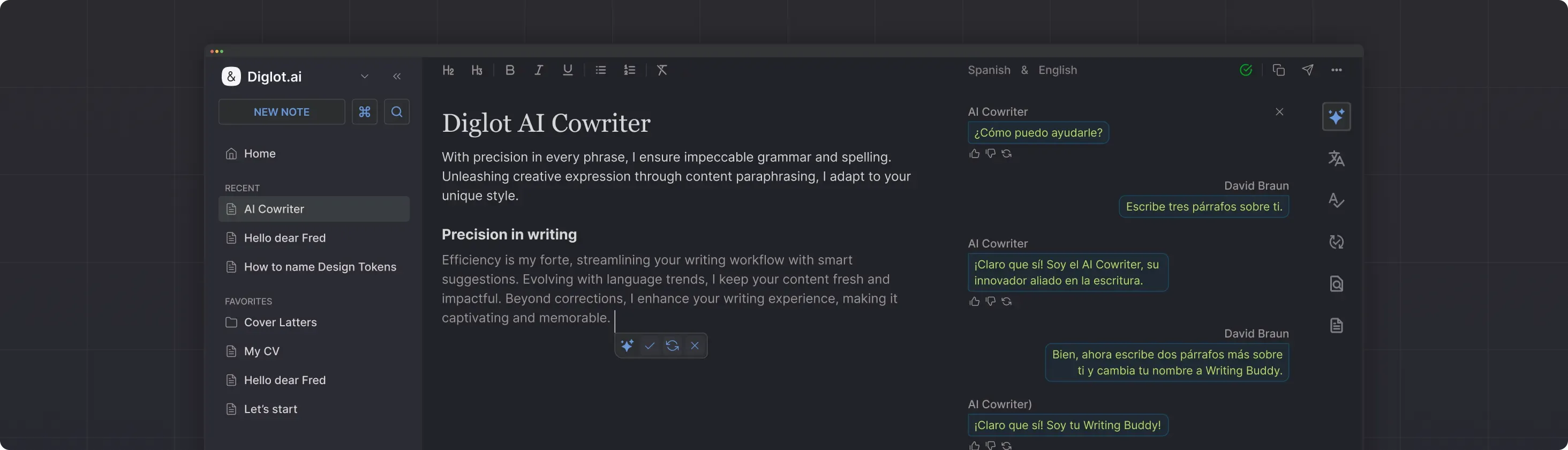
Diglot keeps all these steps in one workspace. Translation, drafting, grammar correction, paraphrasing, and plagiarism checking all share the same document context. The assistant sees your full text, so its suggestions are more relevant than what you get from a disconnected tool.
That workflow difference matters more than any individual feature. When writing is already hard because English is your second language, the last thing you need is a fragmented toolchain.
Try Diglot for free — draft, translate, and refine English in one connected workspace.