

In this article
Bilingual writers face a challenge that monolingual content creators rarely think about: the best version of an idea often lives in one language, but the audience reads another.
For millions of content writers, marketers, and professionals worldwide, the daily job is to produce English content while thinking in Spanish, Mandarin, Arabic, Korean, Portuguese, or another first language. This is not a deficiency. It is a workflow that needs the right tools.
The Real Workflow of Bilingual Content Creation
Most advice about content writing assumes you think in English. The standard tips — outline your post, write a rough draft, edit for clarity — skip the hardest part for non-native writers: getting from a native-language thought to an English sentence that sounds natural.
The real workflow for bilingual writers usually looks like this:
Think in your first language. The idea, the argument, the structure — these form naturally in the language you are most fluent in. Forcing yourself to think in English at this stage often produces shallower ideas.
Translate the core meaning. This is where the work begins. Direct translation rarely produces good English. The sentence structure, idioms, and rhythm of your native language do not map cleanly onto English.
Rewrite for English flow. The translated version needs paraphrasing. Not word swapping — real restructuring so the text reads as if it were written in English originally.
Correct and polish. Grammar checking catches the patterns that translation misses: article usage, preposition choice, verb tense consistency.
Why Separate Tools Break This Workflow
Separate tools break the bilingual writing workflow because each tab loses the context the last one had. The translator does not know what you corrected. The paraphraser does not know what the plagiarism checker just verified. You end up acting as the integration layer, copying text between windows and rebuilding meaning every time you switch.
The problem is not that these tools are bad individually. The problem is context loss. Each tool sees only the text you paste into it. None of them knows what you originally meant in your native language, what you already corrected, or how the paragraph connects to the rest of your document.
This forces you to become the integration layer — copying, pasting, remembering context, and manually ensuring consistency. For a 500-word blog post, this friction adds 20-40 minutes of wasted time.
Connected Translation and Writing in Practice
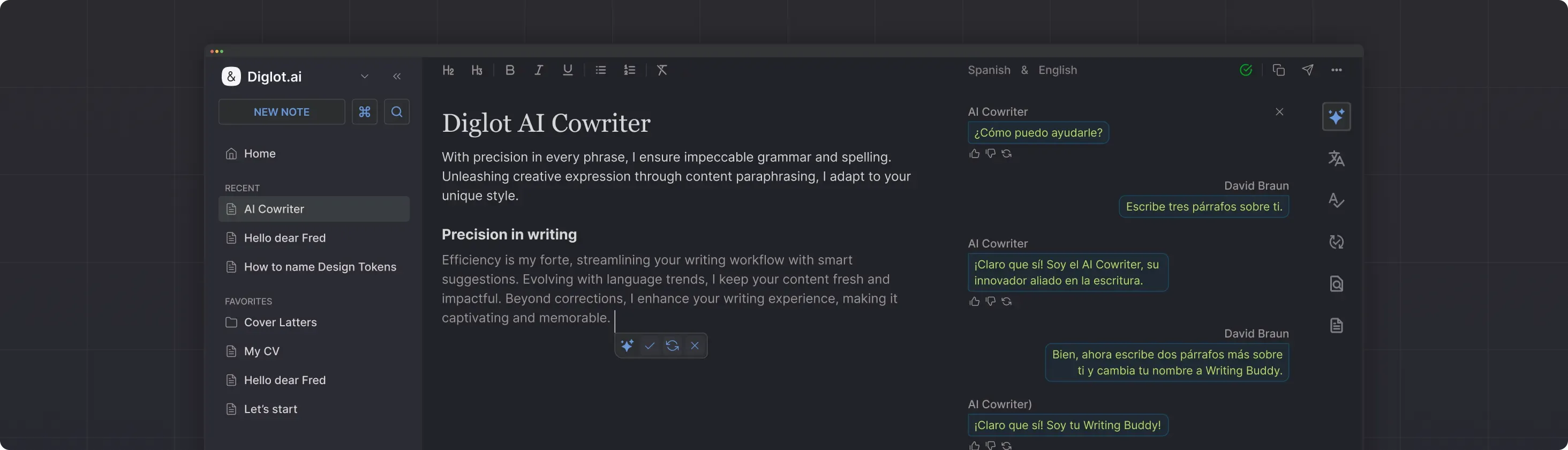
Diglot was built for exactly this workflow. Translation, drafting, grammar correction, paraphrasing, and plagiarism checking all happen inside the same document. When you translate a phrase, the grammar checker already knows the context. When you paraphrase, the plagiarism checker verifies the result immediately.
This matters for content creation because the back-and-forth between languages is not a one-time step. You translate, rewrite, realize the meaning drifted, check the original, adjust, and polish. That loop needs to be fast and frictionless.
Content Types That Benefit Most
Bilingual content tooling helps most where voice and register carry real weight: long-form blog posts and articles that need consistent flow across many paragraphs, professional emails and proposals where awkward phrasing undermines credibility, academic papers, and marketing copy where tone and cultural relevance directly affect whether the reader engages or leaves.
Blog posts and articles. Long-form content where maintaining a consistent voice across many paragraphs requires continuous attention to flow and register.
Professional emails and proposals. Business communication where precision matters and awkward phrasing can undermine credibility.
Academic papers. Research writing where technical accuracy must coexist with natural English expression and proper citation.
Marketing copy. Content where tone, word choice, and cultural relevance directly affect whether the audience engages or moves on.
The Creative Advantage of Being Bilingual
There is an underappreciated advantage to writing content in English as a bilingual person. You bring perspectives, cultural references, and ways of framing problems that monolingual English writers do not have. The goal of any writing tool should be to preserve that advantage, not flatten it into generic English.
That is why the best workflow is one where you write your ideas freely, then use AI to bridge the language gap without losing what makes your perspective valuable.
Try Diglot for free — translate, draft, and refine English content in one bilingual workspace.