

In this article
When non-native English speakers look for writing help, paraphrasing tools are often the first thing they find. The promise is appealing: paste in a sentence, get a better version back.
But for ESL writers, the problem is rarely just one sentence. It is usually a chain: the sentence was translated awkwardly, the grammar is uncertain, the meaning shifted during rewriting, and now you are not sure if the result is too close to the original source.
That is why standalone paraphrasing tools often disappoint. They solve one link in the chain while leaving the others broken.
The Real Writing Challenges for Non-Native Speakers
For ESL writers, the real writing challenges usually layer on top of each other: translation artifacts that produce stiff English, grammar uncertainty around articles and tense, meaning drift during rewrites, and originality concerns when paraphrasing from sources. A paraphraser alone fixes one of these problems while leaving the others untouched in the same sentence.
ESL writing challenges tend to layer on top of each other:
Translation artifacts. When you translate from your native language, the English often has correct grammar but unnatural word order or phrasing. A paraphraser can help here, but only if it understands the broader context.
Grammar uncertainty. Articles, prepositions, and verb tenses are the most common pain points. A paraphraser that ignores grammar produces rephrased text that is still grammatically wrong.
Meaning drift. Every rewrite risks changing what you meant. Non-native speakers have less margin for this because they may not immediately notice when an English phrase shifts meaning subtly.
Originality concerns. Academic and professional writers need to ensure their paraphrased text is genuinely original, not just cosmetically different from the source.
Why Connected Tools Work Better
Connected tools work better because each step can use what the previous step learned. A standalone paraphraser sees one sentence in isolation; it does not know the text was translated from Korean, that the paragraph belongs to a research paper, or that grammar fixes were already applied earlier. Connected tools share that context and produce suggestions that fit the document.
The difference between a helpful paraphrasing workflow and a frustrating one is usually context.
A standalone paraphraser sees one sentence at a time. It does not know that the sentence was translated from Korean, that the paragraph is part of a research paper introduction, or that you already corrected a grammar error in the previous sentence that might recur.
When paraphrasing is connected to the rest of your writing tools — translation, grammar checking, drafting, plagiarism scanning — each step informs the next. The grammar checker catches errors the paraphraser introduced. The plagiarism checker verifies that the rewrite is truly original. The translation context helps the paraphraser suggest more natural alternatives.
When to Paraphrase vs. When to Rewrite
Paraphrasing means expressing someone else's idea in your own words while keeping the same meaning, common in academic writing when citing sources. Rewriting means improving your own awkward English for clarity or flow. Before either, correct grammar errors — paraphrasing broken text produces broken output, no matter how clever the rewrite tool seems.
Paraphrase when: you understand the source material and want to express the same idea in your own words. This is common in academic writing when citing research.
Rewrite when: the text is your own but sounds awkward, too formal, or unclear. This is common after translation or when you wrote directly in English and the result does not flow naturally.
Correct first when: the text has grammar errors. Paraphrasing grammatically broken text usually produces grammatically broken output. Fix the grammar, then decide if the sentence also needs paraphrasing.
A Practical Paraphrasing Workflow
A reliable paraphrasing workflow for ESL writers is a sequence, not a single click. Draft or translate the content, correct grammar so the base text is solid, paraphrase the sentences that still sound unnatural, run an originality check on the result, and read the final version to confirm meaning. Skipping any step makes the next one weaker.
First, draft or translate your content. Second, correct grammar errors so the base text is solid. Third, paraphrase the sentences that still sound unnatural or too close to a source. Fourth, run a plagiarism check on the result. Fifth, read the final version to confirm the meaning matches your intent.
This sequence matters because each step depends on the previous one. Skipping grammar correction before paraphrasing produces worse output. Skipping the plagiarism check after paraphrasing leaves you exposed.
How Diglot Connects the Chain
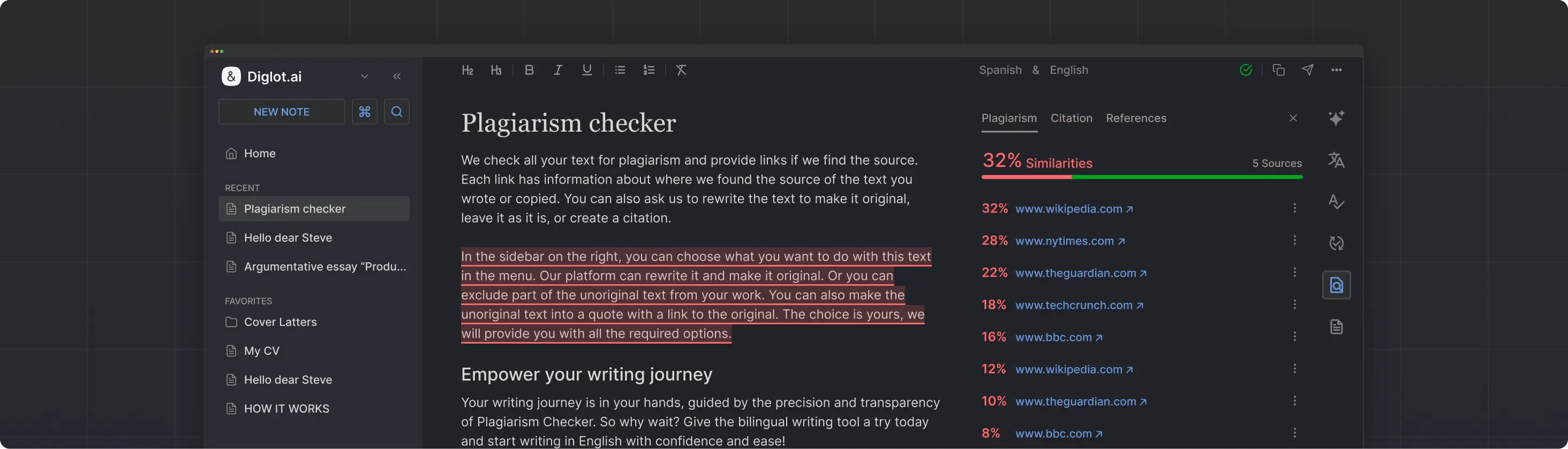
Diglot is built for the exact paraphrasing sequence above. All five steps happen inside the same workspace, with translation, grammar checking, paraphrasing, and originality verification sharing document context. The paraphraser knows what language you translated from, which corrections already landed, and where you are working in the document, so suggestions stay coherent.
The paraphrasing tool shares context with the grammar checker and plagiarism scanner. It knows what language you translated from, what corrections were already applied, and where in the document you are working. That shared context produces better suggestions than any isolated paraphrasing box.
Try Diglot for free — paraphrase, correct grammar, and check originality in one connected workflow.