How Many Paragraphs and Sentences Are in 300, 400 or 500 Words?
A quick reference for how many paragraphs, sentences and pages a given word count usually means, with a table from 250 to 2,000 words and the assumptions behind each number.
Diglot.ai's AI Writing Assistant helps with drafting, grammar, style, and originality, so your writing reads more professional.

A quick reference for how many paragraphs, sentences and pages a given word count usually means, with a table from 250 to 2,000 words and the assumptions behind each number.

Forty wordy phrases that pad English writing, each with a shorter replacement, plus a before-and-after paragraph and an explanation of why second-language writers over-pad.
The full list of overused ChatGPT words — delve, tapestry, testament, moreover, pivotal and the rest — plus the part the listicles skip: many of these are classic formal-register ESL words, deleting them does not stop text from sounding like AI, and what actually fixes AI-sounding writing is rhythm, not vocabulary.
The MIT Media Lab EEG study found that people who wrote essays with ChatGPT showed weaker neural connectivity and could not quote their own text. It did not prove AI makes us dumber. Here is what "cognitive debt" actually means, why full ghostwriting is the real problem, and the scaffolded middle path for second-language writers.
Exophony means writing in a language that is not your mother tongue. Conrad did it, Nabokov did it, and so does every international student and remote worker drafting in English today. What exophonic writers say about the strange freedom of a second language, why the literary version wins prizes while the everyday version gets flagged by AI detectors, and what a tool built for the condition looks like.
Chinese universities discontinued about 12,200 undergraduate programs between 2021 and 2025. This guide shows international applicants how to explain a cut major in a statement of purpose: one factual sentence, agency verbs, recommender alignment, and a mid-cycle documentation checklist.
Most workplace text is AI-generated now, and readers have learned to skim it and stop. Writing that sounds like a specific person is scarce attention capital — and slightly imperfect, unmistakably human English from non-native professionals beats polished generic output.
International students need three things at once: bilingual help, real learning, and academic-integrity safety — because they are also the most likely to be falsely flagged as AI cheats. Here are ten tools judged on the axes that actually matter.
Most "Grammarly alternatives" are monolingual English engines that assume you already think in English. For non-native writers, the real need is bilingual, L1-aware help. Here are eight tools compared on the axes that actually matter.
For non-native professionals, the barrier to credible business English is not grammar — it is register, directness, and concision. Here are the few learnable conventions that fix most of it, with before-and-after examples you can use today.
Paperpal is a mature academic writing assistant; Diglot competes on a different axis — a bilingual, L1-aware workspace with verifiable proof of authorship. Here is an honest, feature-by-feature comparison for non-native researchers.
In academic English, certainty is a calibration, not a default — your language has to match the strength of your evidence. Here is the hedging toolbox, when to be confident instead, and why non-native writers so often over- or under-claim.
When you use ChatGPT in academic work, you usually have to cite it — and APA, MLA, and Chicago each do it differently. Here is the exact official template and a worked example for all three, plus the rule everyone gets wrong.
Vibe coding let developers describe intent and let AI write the code. Vibe writing is the same move for prose — you bring the meaning, AI helps shape the English. Here is what it means, why it fits non-native writers, and how to do it without losing your voice.
Your grammar is correct, but the sentences still read "off." Here are the seven patterns that make non-native English sound clunky — and how to smooth each one.
The better your English grammar gets, the more AI detectors suspect your writing. Here is why textbook-perfect English triggers false positives — and practical strategies to write naturally without dumbing down your language.
Professional email in English is a narrow genre: a few conventions decide whether you sound clear and polite—or stiff, cold, or unsure. This guide shows how non-native writers can write professional emails in English with a repeatable structure, safer phrasing, and a pre-send check.
Writing in English when it's not your first language is hard — but not because your ideas are weak. Here are 7 practical strategies to write faster, clearer, and more confidently.
Use these Diglot workflow tips to save time on drafting, editing, paraphrasing, and grammar correction.
See how Diglot's AI Writing Assistant helps you draft faster, sharpen phrasing, and write polished English with confidence.
Learn how Diglot's AI writing assistant helps you draft faster, improve grammar, and write clearer English with real-time support.
Artificial intelligence has become a fundamental part of content creation. Platforms like Diglot.ai offer an AI Writing Assistant that can reshape how you draft, revise, and improve English text inside one workflow.
Diglot.ai’s AI Writing Assistant is designed to support writers, students, marketers, and journalists in improving the quality of their texts. It analyzes your input and suggests stronger phrasing, sentence restructuring, and next-draft options that help refine your document.
A significant benefit of using an AI Writing Assistant is its ability to adapt to your unique writing style. This helps each piece stay personal while improving clarity and originality for academic and professional writing.
The use of AI in writing also saves time. The AI Writing Assistant can generate multiple improvements quickly, speeding up the editing process and allowing you to focus on the more creative aspects of your work.
Moreover, the AI Writing Assistant can analyze and optimize text for better audience engagement, so your content stays clear and relevant to the reader.
It is important to remember that while AI tools in writing are incredibly helpful, they are meant to complement rather than replace human creativity and intuition. The AI Writing Assistant expands the capabilities of the author rather than replacing them.
As AI technology continues to evolve, tools like Diglot.ai’s AI Writing Assistant will continue helping users craft compelling, high-quality content for email, research, and marketing work.
Ready to put it into practice? Try Diglot's tool →
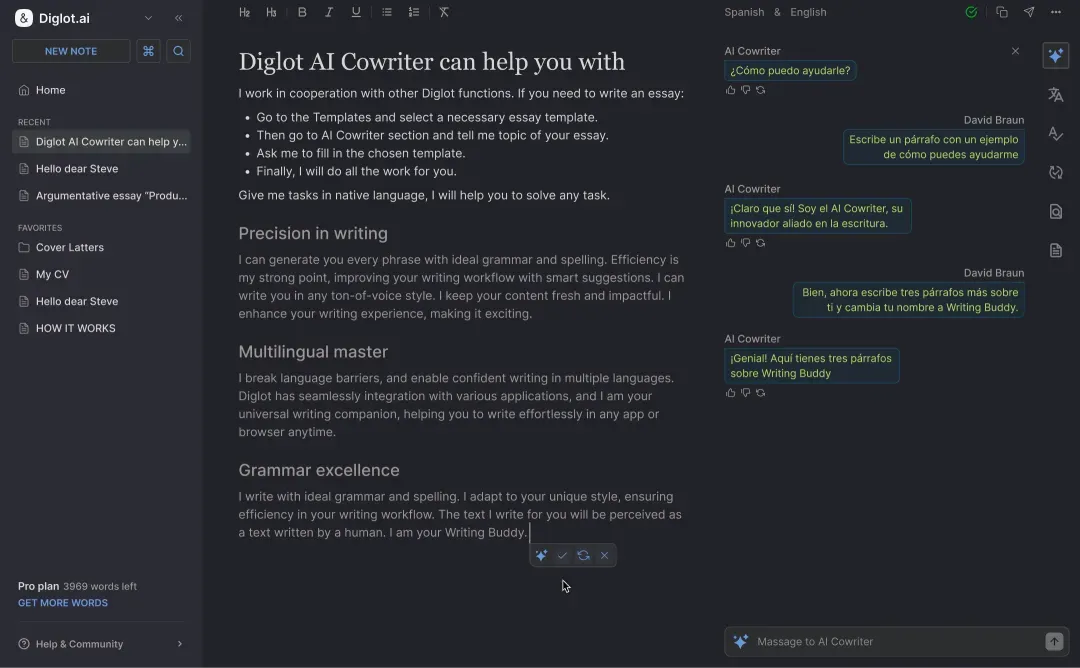
Draft, refine, and rewrite English with AI support built for non-native speakers.
Translate, compare, and edit multilingual text in one writing workflow.
Catch grammar, spelling, and punctuation issues while you write in English.
Rewrite sentences, improve fluency, and keep your original meaning clear.
A signed, verifiable record of how your text was written inside Diglot — writing-process evidence you can share.
Move from rough bilingual drafts to clearer English in one connected writing workflow.