AI Plagiarism Checker for Students & ESL Writers
Diglot scans your essay, research paper, or content draft for overlap against a broad database, surfaces flagged passages inline, and lets you rewrite them with the built-in L1-aware paraphraser — all in the same editor. Built for ESL students who translate source material while drafting and need an originality safeguard before submission, plus AI-detection passes for content that needs to read as human-written.
*No credit card required
Why ESL writers need plagiarism checking inside the editor
Most plagiarism checkers (Turnitin, Copyleaks, Grammarly) live outside your writing workflow — copy text into the checker, review a report, copy it back, rewrite, repeat. For ESL writers translating from L1 source material, this loop runs three or four times per draft. Diglot keeps scanning, flagging, paraphrasing, and citation-prompting inside one editor, so the originality pass takes minutes, not hours.
Apologetic fluff & boilerplate
Defaults to verbose, deferential openings ("I hope this email finds you well", "I am writing to kindly inquire"). Reads as subordinate and wastes senior stakeholders' time.
Native-speaker syntax bias
Catches basic comma splices and spelling typos, but completely misses L1 cultural transfers, Japanese Keigo servility, Spanish false cognates, or tone mismatch.
Isolated sentence translation
Translates sentences accurately in isolation, but lacks document-level tone calibration, context memory, and consistent business terminology across releases.
Calibrated executive workspace
In-place three-tier translation, register calibration, L1-transfer neutralization, and persistent translation memory inside a single focused editor.
Built around real bilingual business workflows
Everything non-native professionals need to write, translate, and verify high-stakes English in one place.
Register & Formality Calibrator
Calibrate writing to target US vs UK executive norms. Neutralize Keigo-style subservience, legalese filler, and culturally awkward greetings before sending to leadership.
- Senior Executive vs Peer tone tuning
- Eliminates "kindly", "as per", and "revert"
- Action-oriented CTA phrasing
Three-Tier Inline Translation
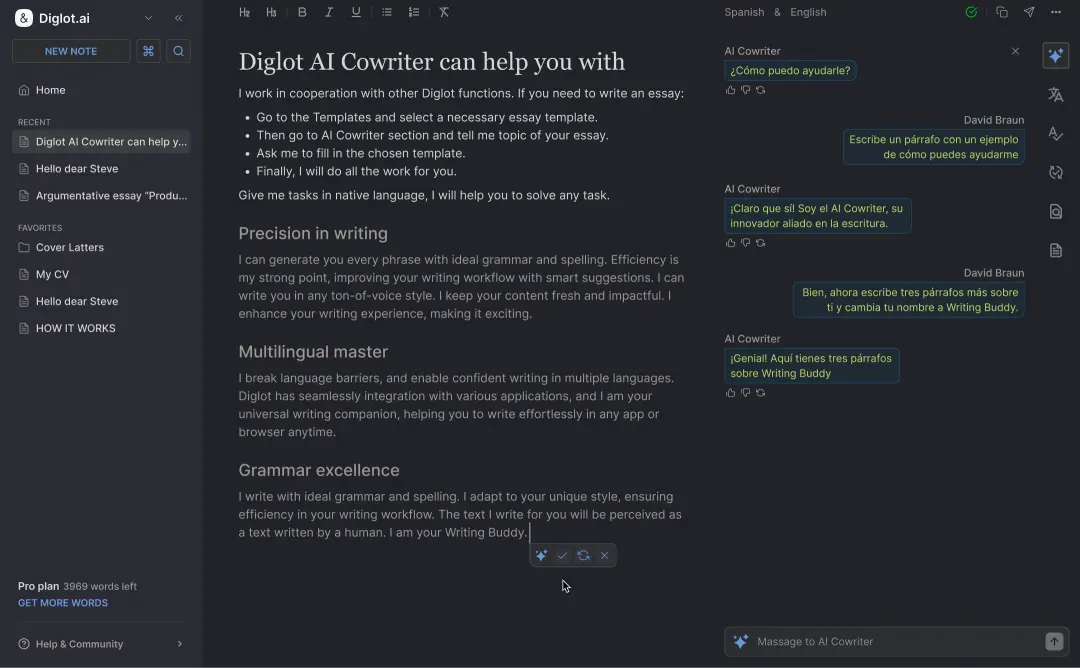
Translate difficult words or full sentences inline without leaving the editor. View Literal, Idiomatic, and Executive Business translations side-by-side.
- In-place paragraph translation
- Literal vs Idiomatic vs Executive tiers
- Preserves source context and document formatting
Persistent Translation Memory
Brand names, product terms, contractual clauses, and company acronyms stay 100% consistent across every email, proposal, and report you write.
- Locked vocabulary across documents
- Shared team glossaries
- Zero terminology drift between releases
AI Cowriter for Business Formats
Transform rough bullet points, meeting notes, or native-language thoughts into polished client emails, status memos, and executive decks in seconds.
- Instant expansion of rough bullet notes
- Calibrated for non-native thinking habits
One connected workflow from raw draft to final deliverable
Move from bilingual rough ideas to polished English in one calm flow instead of stitching together separate tools.
Start with a preview
Run a quick originality check first to see whether the document needs deeper review before spending a full scan.
Inspect flagged overlap
Open sources, review matching fragments, and decide which passages need to be rewritten, excluded, or cited.
Fix the issue in the same editor
Move directly from a flagged fragment into paraphrasing or rewriting without exporting the text elsewhere.
Prepare a cleaner final submission
Generate references, clean up citations, and keep originality review part of the writing workflow instead of a last-minute panic.
Built for high-stakes business communicators
Diglot works best when English is your delivery language, but not always your thinking language.
International students
Move from rough documents to cleaner English submissions with structure, paraphrasing, and grammar review in one place.
Researchers and graduate writers
Keep academic structure and wording quality in one workflow when your final output needs to sound precise and credible.
Bilingual creators
Turn ideas that start in your native language into natural English copy without bouncing between translation and rewrite tools.
Confidentiality & editorial standards
Your business drafts, customer proposals, and internal communications belong strictly to your team.
Zero model training on your data
Your drafts, emails, and translations are never used to train public AI models. Data is encrypted in transit and at rest with strict multi-tenant isolation.
Calibrated specifically for non-native professionals
Examples, register models, and workflow conventions are shaped for managers, engineers, and consultants who need confident English output without losing meaning.
Reviewed by Diglot Editorial Team
Page updated May 22, 2026. We regularly update guidelines as international business English standards and corporate communication norms evolve.
Frequently asked questions
Everything you need to know before getting started.
Who should use the Diglot plagiarism checker?
ESL students writing essays and theses, academic researchers preparing journal submissions, content marketers checking before publishing, and anyone whose work has citation risk or AI-detection exposure. The integrated paraphraser is especially useful for non-native writers who translate source material during drafting, since translation-derived overlap is a common failure mode.
How is Diglot different from Turnitin, Copyleaks, or Grammarly's checker?
Turnitin lives inside university LMS systems — students submit and wait for results. Copyleaks and Grammarly run as separate scans outside the writing workflow. Diglot keeps scanning, flagging, paraphrasing, and citation prompting inside one editor, so the originality pass takes minutes per draft. The integrated paraphraser is L1-aware for ESL writers.
Can I fix flagged passages inside Diglot?
Yes — that is the core workflow. Click any flagged passage and Diglot offers two paths: paraphrase the text with the L1-aware rewriter (preserves meaning, swaps L1-flavored phrasing for natural English), or insert an inline citation with a prompt for the source URL. Both actions happen inside the same editor as the original draft.
Does it replace proper citations?
No — a plagiarism checker identifies overlap, but you still need to quote and cite sources correctly. Diglot helps by flagging where citations may be missing and offering a citation-hint mode that prompts you to add an inline citation when overlap is detected. The decision to quote, paraphrase, or cite remains yours; the tool surfaces the risk early.
Is it useful for non-native English writers?
Yes — non-native writers often paraphrase source material while translating ideas from their L1, which can produce passages that look overlap-y to a plagiarism checker even when the intent is original synthesis. Diglot recognizes translation-derived overlap, offers L1-aware rewrites that preserve meaning, and surfaces both originality and AI-detection risk in the same inline review.
Can I use the plagiarism checker on an essay before turning it in?
Yes — it is built for pre-submission use. Run a scan on your draft, review flagged passages inline, paraphrase or cite as needed, and verify the result is below your institution's overlap threshold before submitting. The whole loop happens in the same editor where you wrote the draft, so you do not have to export and re-import between checks.
Explore all Diglot workflows
Discover specialized tools built to support your English writing from rough notes to polished delivery.
Draft, refine, and rewrite English with AI support built for non-native speakers.
Translate, compare, and edit multilingual text in one writing workflow.
Catch grammar, spelling, and punctuation issues while you write in English.
Rewrite sentences, improve fluency, and keep your original meaning clear.
A signed, verifiable record of how your text was written inside Diglot — writing-process evidence you can share.

See how Diglot's AI plagiarism checker helps detect overlap, protect originality, and improve trust in written work.

Three typical workflows — an international student, a professional and a bilingual creator — and what they have in common.
Three different answers to one question: detectors do not care that it was Grammarly, some university policies name it explicitly, and students have been penalised. What matters is the function you used — spellcheck and rewrite are not the same act. Sourced, dated, and checked against the vendors own documentation.
Write in your language,
publish in English
Move from rough bilingual drafts to clearer English in one connected writing workflow.
An AI plagiarism checker for ESL students and academic writers needs to do more than return a similarity score — it needs to fit inside the writing workflow where flagged passages can be fixed immediately. Most plagiarism checkers (Turnitin, Copyleaks, Grammarly's integrated scanner) live outside the editor: copy your draft into the checker, wait for a report, scroll through highlights, copy the text back into your editor, rewrite, repeat. For ESL writers who translate source material while drafting, this loop runs three or four times before submission — and translation-derived overlap is a particularly common failure mode because paraphrasing across languages can leave structural similarity even when the wording changes. Diglot keeps the entire originality pass inside one editor. Scans highlight overlap inline in your draft, not in a separate report. Each flagged passage offers two paths: paraphrase with the L1-aware rewriter (which handles Korean topic-comment word order, Spanish false cognates, Chinese aspect markers, and other transfer patterns natively), or insert an inline citation with a source URL prompt. AI-text detection runs in the same pass, so you also verify that translated or ChatGPT-assisted drafts read as human-written before submission. The result: an originality pass that takes minutes instead of hours, with the paraphraser and grammar checker built into the same workspace.
