Academic writing for ESL students

AI Writing Tool for ESL Students

Diglot is built for ESL students writing essays, research papers, lab reports, and theses in English. L1-aware grammar checking explains corrections in your native language, the paraphraser handles translation-flavored sentences, and the originality checker catches overlap before submission. Six L1s covered deeply (Korean, Chinese, Japanese, Spanish, Russian, Arabic) so first-year undergrads through PhD candidates get calibrated help.

Start for free

*No credit card required

Inside Diglot
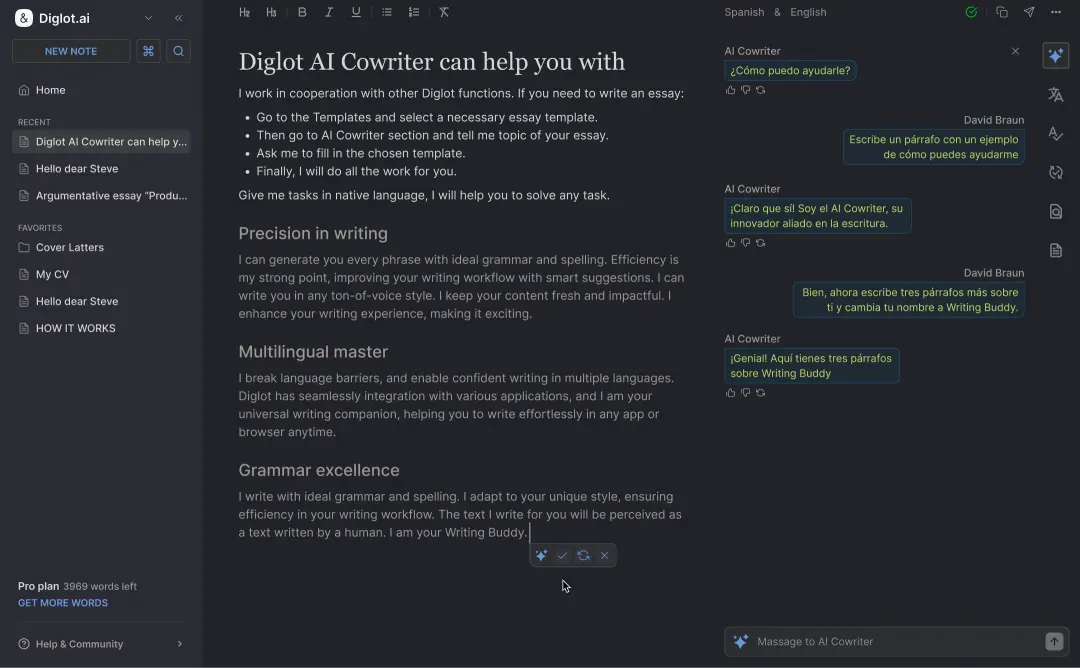
One connected editing flow

Most "AI writing tools for students" (Grammarly, QuillBot, Turnitin) were built around native-English students who occasionally need a typo flagged. ESL students face a different problem: their ideas are clear in Korean, Chinese, Spanish, or Russian, but the English output reads as translated. Diglot recognizes which patterns are L1 transfer (predictable, fixable) versus genuine vocabulary or argument issues (need study, not auto-fix).

  • L1-aware grammar — fixes article omissions, tense shifts, and false cognates with explanations in your L1
  • Academic templates — IMRaD research papers, essay structures, grant abstracts with register guidance
  • Originality check + paraphrase — catch translation-derived overlap before submission, fix it in the editor
Draft, refine, and deliver English in one calm workspace.
Diglot ESL student writing workflow — bilingual editor with grammar and originality

Why ESL students need more than a generic student writing tool

Most "AI writing tools for students" (Grammarly, QuillBot, Turnitin) were built around native-English students who occasionally need a typo flagged. ESL students face a different problem: their ideas are clear in Korean, Chinese, Spanish, or Russian, but the English output reads as translated. Diglot recognizes which patterns are L1 transfer (predictable, fixable) versus genuine vocabulary or argument issues (need study, not auto-fix).

Built for the bilingual student workflow

Read source material in your L1, draft notes in your L1, translate to English, polish the language. Diglot keeps the L1 source anchored on screen while you work — no copy-pasting between Google Translate, Grammarly, and Turnitin.

L1-aware feedback, not generic correction

Korean students see article-omission fixes explained against Korean grammar. Spanish students see false-cognate alerts against their L1. Chinese students see aspect-marker mappings. Each correction teaches the pattern, not just fixes the symptom.

Originality + AI-detection in one pass

Universities now check for both plagiarism AND AI-generated text. Diglot runs both in the same scan, and the L1-aware paraphraser can rework flagged passages while preserving citations — submitting with confidence in 20 minutes instead of 2 hours.

How this workflow works

Move from bilingual rough ideas to polished English in one calm flow instead of stitching together separate tools.

Inside this workflow

What you can do with Diglot

Use this workflow to move from bilingual drafts to cleaner English output without breaking your editing flow across separate tools.

What this module includes

The module is not just one button. It is a focused part of the Diglot workspace with real writing actions, review controls, and context-aware output.

Who this is built for

Diglot works best when English is your output language but not always your thinking language.

Editorial review

Why trust this workflow

This page is written for non-native English speakers and reviewed against the current Diglot workflow, not against a generic AI copy template.

Workflow fit

Built around real bilingual writing tasks

The guidance on this page reflects how Diglot handles drafting, translation, grammar review, paraphrasing, and originality checks inside one editor.

Audience fit

Written for people who think in one language and deliver in English

Examples, copy, and workflow steps are shaped for students, professionals, and creators who need clearer English output without losing meaning.

Editorial review

Reviewed by Diglot Editorial Team

Last reviewed on April 11, 2026. We update these landing pages when the workflow, module behavior, or recommended writing path changes.

Frequently asked questions

Everything you need to know before getting started.

Yes — academic writing is one of the strongest use cases. Diglot handles essays (high school through graduate), IMRaD research papers, lab reports, grant abstracts, thesis chapters, and reviewer-response letters. Each document type has format-specific templates with register notes calibrated for non-native English speakers (when to hedge, how formal to go, common L1-influenced phrasings to avoid).

Yes — Diglot is built for ESL students from the ground up. Six L1s covered with deep contrastive linguistics data (Korean, Chinese, Japanese, Spanish, Russian, Arabic). Grammar corrections are explained in your L1 context, not generic English rules. The paraphraser handles L1-flavored sentences. The translator anchors your L1 source. Generic student writing tools treat ESL students as if they were sloppy native writers.

Yes — Diglot includes both plagiarism overlap scanning and AI-text detection in the same inline review. Flagged passages can be paraphrased with the L1-aware rewriter (which preserves meaning and prompts for citations when relevant) without leaving the editor. The whole originality pass takes 10-20 minutes per draft instead of the 1-2 hours Turnitin + Grammarly + manual rewriting typically takes.

No — formal instruction and instructor feedback remain irreplaceable for argument quality, discipline-specific conventions, and learning to think academically. Diglot handles the language-mechanics layer (grammar, fluency, originality, translation) so tutoring time can focus on higher-order issues. ESL students often find this division makes both work better.

Yes — Diglot is useful any time you produce written English. Homework essays, practice argumentative essays, written-exam preparation (TOEFL, IELTS, GRE Analytical Writing), and graduate qualifying exams all benefit from the L1-aware grammar checker and paraphraser. Test-prep mode disables certain features (like AI drafting) to keep you within practice rules.

Yes — graduate ESL students are one of the strongest fit segments. Thesis chapters, journal article drafts, conference papers, grant proposals, and reviewer-response letters all require sustained register discipline that Diglot encodes into templates. The L1-aware paraphraser handles long subordinate chains common in academic prose; translation memory keeps technical terms consistent across an 80-page thesis.

Write in your language,
publish in English

Move from rough bilingual drafts to clearer English in one connected writing workflow.

Start for free

*No credit card required

Diglot.ai - bilingual writing tool, write and translate in one app