AI Writing Tool for ESL Business Professionals
Calibrate business register, eliminate L1 false friends, and deliver senior, concise English in one calm workspace — without switching between DeepL, Grammarly, and ChatGPT.
*No credit card required
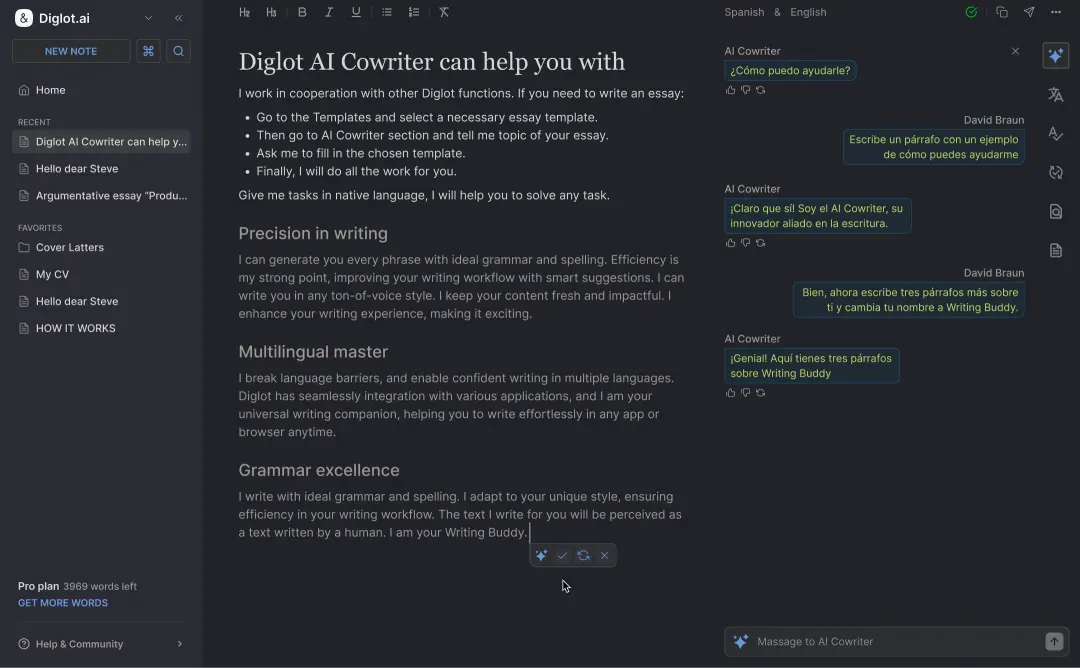
Renewal coverage closed the quarter at 91% of the enterprise book, two points ahead of plan. The three accounts still open all cite the same blocker — a data-residency clause our current addendum does not covers — and legal has a redraft in review (Legal memo, 12 Sep).
Net expansion came from seat growth rather than price. That is the healthier of the two paths, but it leaves us dependant on headcount at four accounts, so I have flagged those in the risk table and proposed a usage-based floor for the next cycle.
Check spelling and grammar for the current document.
Check grammar- does not covers does not cover did not cover
- dependant dependent depending
- provide an update on update report on
Illustrative editor preview with sample text. Create an account to work on your own draft.
Why standard AI tools fail ESL business professionals
Generic tools assume native-speaker intuition. Non-native pros waste hours re-editing drafts across three separate apps, only to sound overly apologetic or translated.
Apologetic fluff & boilerplate
Defaults to verbose, deferential openings ("I hope this email finds you well", "I am writing to kindly inquire"). Reads as subordinate and wastes senior stakeholders' time.
Native-speaker syntax bias
Catches basic comma splices and spelling typos, but completely misses L1 cultural transfers, Japanese Keigo servility, Spanish false cognates, or tone mismatch.
Isolated sentence translation
Translates sentences accurately in isolation, but lacks document-level tone calibration, context memory, and consistent business terminology across releases.
Calibrated executive workspace
In-place three-tier translation, register calibration, L1-transfer neutralization, and persistent translation memory inside a single focused editor.
See how Diglot elevates your business English
Compare rough drafts written with L1 influence against Diglot’s calibrated executive output.
Dear Mr. Miller, I am writing to kindly update you regarding the delay with the Q3 release. We are very deeply sorry for the inconvenience caused, and per our discussion yesterday we are working hard to resolve the issue as soon as possible. Please kindly revert back with your confirmation.
Hi David — Following up on our Q3 release schedule. We adjusted the rollout window by 48 hours to complete final security validation. European cloud deployment remains on track for September 18th. Please let me know by Thursday 5 PM if this window works for your team.
Hello Sarah, I hope this email finds you well. As per our conversation, I am sending you the quotation for our Enterprise plan. Please find attached the document. In case you have any doubt, do not hesitate to contact me at your earliest convenience.
Hi Sarah — Attached is the enterprise licensing proposal reflecting the 200-seat volume tier and Tier-1 SLA we agreed on Tuesday. Onboarding kicks off within two business days of signing. Let’s connect for 10 minutes on Friday to finalize procurement.
To all stakeholders, I would like to report that the migration project is having some small problems with the legacy database. We are trying to do our utmost best to fix it. We hope everything will be fine by next week.
Team — Q3 database migration update: PostgreSQL schema transitions are 90% complete. We scheduled a zero-downtime hotfix for Wednesday 11 PM UTC to resolve a legacy table constraint. Zero user impact expected.
Built around real bilingual business workflows
Everything non-native professionals need to write, translate, and verify high-stakes English in one place.
Register & Formality Calibrator
Calibrate writing to target US vs UK executive norms. Neutralize Keigo-style subservience, legalese filler, and culturally awkward greetings before sending to leadership.
- Senior Executive vs Peer tone tuning
- Eliminates "kindly", "as per", and "revert"
- Action-oriented CTA phrasing
Three-Tier Inline Translation
Translate difficult words or full sentences inline without leaving the editor. View Literal, Idiomatic, and Executive Business translations side-by-side.
- In-place paragraph translation
- Literal vs Idiomatic vs Executive tiers
- Preserves source context and document formatting
Persistent Translation Memory
Brand names, product terms, contractual clauses, and company acronyms stay 100% consistent across every email, proposal, and report you write.
- Locked vocabulary across documents
- Shared team glossaries
- Zero terminology drift between releases
AI Cowriter for Business Formats
Transform rough bullet points, meeting notes, or native-language thoughts into polished client emails, status memos, and executive decks in seconds.
- Instant expansion of rough bullet notes
- Calibrated for non-native thinking habits
One connected workflow from raw draft to final deliverable
Move from bilingual rough ideas to polished English in one calm flow instead of stitching together separate tools.
Capture the message quickly
Start from rough documents or meeting takeaways when you need to communicate in English under time pressure.
Refine tone for the audience
Use AI drafting, translation, and paraphrasing to make the wording sound more natural and more professional.
Review before sending
Run grammar and clarity checks without exporting the draft to a separate proofing tool.
Reuse the workflow for recurring documents
Carry the same approach into proposals, client emails, reports, and internal docs so English writing becomes faster over time.
Built for high-stakes business communicators
Diglot works best when English is your delivery language, but not always your thinking language.
Multilingual professionals
Write faster for work without sounding translated. Diglot helps you refine tone, clarity, and confidence before you hit send.
Cross-border teams
Keep messaging consistent when ideas originate in multiple languages but final documents, emails, and proposals need polished English.
Bilingual creators
Turn ideas that start in your native language into natural English copy without bouncing between translation and rewrite tools.
Confidentiality & editorial standards
Your business drafts, customer proposals, and internal communications belong strictly to your team.
Zero model training on your data
Your drafts, emails, and translations are never used to train public AI models. Data is encrypted in transit and at rest with strict multi-tenant isolation.
Calibrated specifically for non-native professionals
Examples, register models, and workflow conventions are shaped for managers, engineers, and consultants who need confident English output without losing meaning.
Reviewed by Diglot Editorial Team
Page updated May 22, 2026. We regularly update guidelines as international business English standards and corporate communication norms evolve.
Frequently asked questions
Everything you need to know before getting started.
Can Diglot help with business writing?
Yes — business writing is the strongest use case for ESL professionals. Diglot covers transactional emails (status, follow-up, cold outreach), sales proposals, customer-success communications, status reports, performance reviews, executive presentations, vendor scoping, and internal documentation. Each format has register guidance calibrated for US vs UK conventions and L1-specific pitfalls.
Is it only for native speakers?
No — Diglot is specifically built for ESL professionals. Generic business writing tools (Grammarly Business, Wordtune Business) assume native-English baselines. Diglot calibrates for the predictable L1-transfer patterns: Japanese over-formalization, Korean honorific-derived politeness, Spanish false cognates, Chinese aspect-marker flattening, Russian long subordinate chains, Arabic definite-article overuse. Each is recognized and explained, not just flagged.
Can I use Diglot for multilingual client communication?
Yes — multilingual client comms is a core use case. Translate inbound client emails from their L1 into English, draft responses in your L1, translate to English with three-tier output (literal/idiomatic/formal), polish with the L1-aware grammar checker. Translation memory keeps client-specific terminology consistent across every touchpoint. Especially valuable for sales engineers, customer success leads, and account managers handling cross-border accounts.
Does Diglot help with tone and wording?
Yes — tone and register are first-class concerns. The AI writing assistant adapts output to target register (executive, peer, vendor, customer). The paraphraser offers tone modes (formal, conversational, direct). The grammar checker flags register mismatches — over-formal openings, under-formal CTAs, locale-confused phrasings ("kindly" in US business, "revert" for "reply" outside Indian English). Result: your emails sound like a confident senior, not a translated junior.
Is Diglot useful for remote teams that work in English?
Yes — distributed teams with ESL members benefit most. Team accounts share translation memory and approved phrasings, so onboarding new hires keeps voice consistent without re-explaining conventions. Async-friendly tools (paraphrasers, register-aware suggestions) reduce the synchronous review burden senior native-English colleagues otherwise carry. Multilingual standup notes, sprint reports, and decision docs all stay polished.
How does Diglot reduce time spent on business writing?
Two ways: (1) L1-aware corrections explain patterns in your native language, so you internalize the pattern and produce cleaner first drafts over time. (2) The unified editor (grammar + paraphrase + translation) eliminates the 3-tab juggle that doubles editing time. Senior ESL professionals report 30-60 minute savings per week on email alone.
Explore all Diglot workflows
Discover specialized tools built to support your English writing from rough notes to polished delivery.
Draft, refine, and rewrite English with AI support built for non-native speakers.
Translate, compare, and edit multilingual text in one writing workflow.
Catch grammar, spelling, and punctuation issues while you write in English.
Rewrite sentences, improve fluency, and keep your original meaning clear.
A signed, verifiable record of how your text was written inside Diglot — writing-process evidence you can share.

Use these Diglot workflow tips to save time on drafting, editing, paraphrasing, and grammar correction.

Learn how Diglot's AI writing assistant helps you draft faster, improve grammar, and write clearer English with real-time support.
Three different answers to one question: detectors do not care that it was Grammarly, some university policies name it explicitly, and students have been penalised. What matters is the function you used — spellcheck and rewrite are not the same act. Sourced, dated, and checked against the vendors own documentation.
Write in your language,
publish in English
Move from rough bilingual drafts to clearer English in one connected writing workflow.
ESL business professionals — product managers at multinational companies, consultants serving cross-border clients, sales engineers running deals in English, customer success leads handling escalations, marketers producing English content — face a specific challenge that generic business writing tools were never designed for: they need polished, register-appropriate business English at the pace of daily work, not the pace of careful editing.
Native business English carries conventions native speakers absorb implicitly but ESL professionals must learn deliberately: US business email defaults 50-150 words (compared to 300+ in Japanese keigo-influenced English); subject lines should signal action ("Decision needed: Q3 budget") rather than just topic ("Q3 budget"); "kindly" reads as servile in American English even though it sounds polite to Indian or South Asian writers; "as per" reads as legalese to most US readers but is standard in Indian and British business English; "revert" means "reply" in Indian English but means "return to a prior state" to US readers.
These register conventions multiply across L1s — Japanese keigo doesn't map cleanly to US neutral; Korean honorific levels produce English that reads as servile; Spanish formality (tú/usted) doesn't carry to English; Chinese politeness markers are less morphologically explicit and can read as cold; Russian directness reads as curt in American business contexts. Diglot encodes all of these conventions plus L1-specific calibration. The grammar checker recognizes L1-transfer patterns and explains corrections with the native-language reason. The paraphraser offers tone modes calibrated for target audience (executive, peer, vendor, customer).
The translation memory keeps brand names, product terms, and contract language consistent across every email, proposal, and report. The grammar checker, paraphraser, translation memory, and AI writing assistant share document context inside one editor — so the workflow stops requiring DeepL + Grammarly Business + QuillBot + ChatGPT in four browser tabs.
