

In this article
Wordtune became popular by promising one thing clearly: make existing English sound better. For many users, that is enough. You write the draft yourself, then Wordtune helps you tighten phrasing, shorten long sentences, or shift tone.
But for non-native English speakers, the challenge usually starts earlier. The hardest part is often getting from a thought in your native language to a natural English sentence in the first place. That is why Diglot and Wordtune solve different versions of the same problem.
What Wordtune Does Well
Wordtune is strong at clarity-oriented rewriting. It is especially helpful when the meaning is already there but the sentence feels too stiff, too long, or not quite natural. Its suggestions can make English more concise without forcing you to rebuild the paragraph manually.
That makes Wordtune useful for professionals, marketers, and students who already draft directly in English and want a cleaner final version.
Where Diglot Goes Further
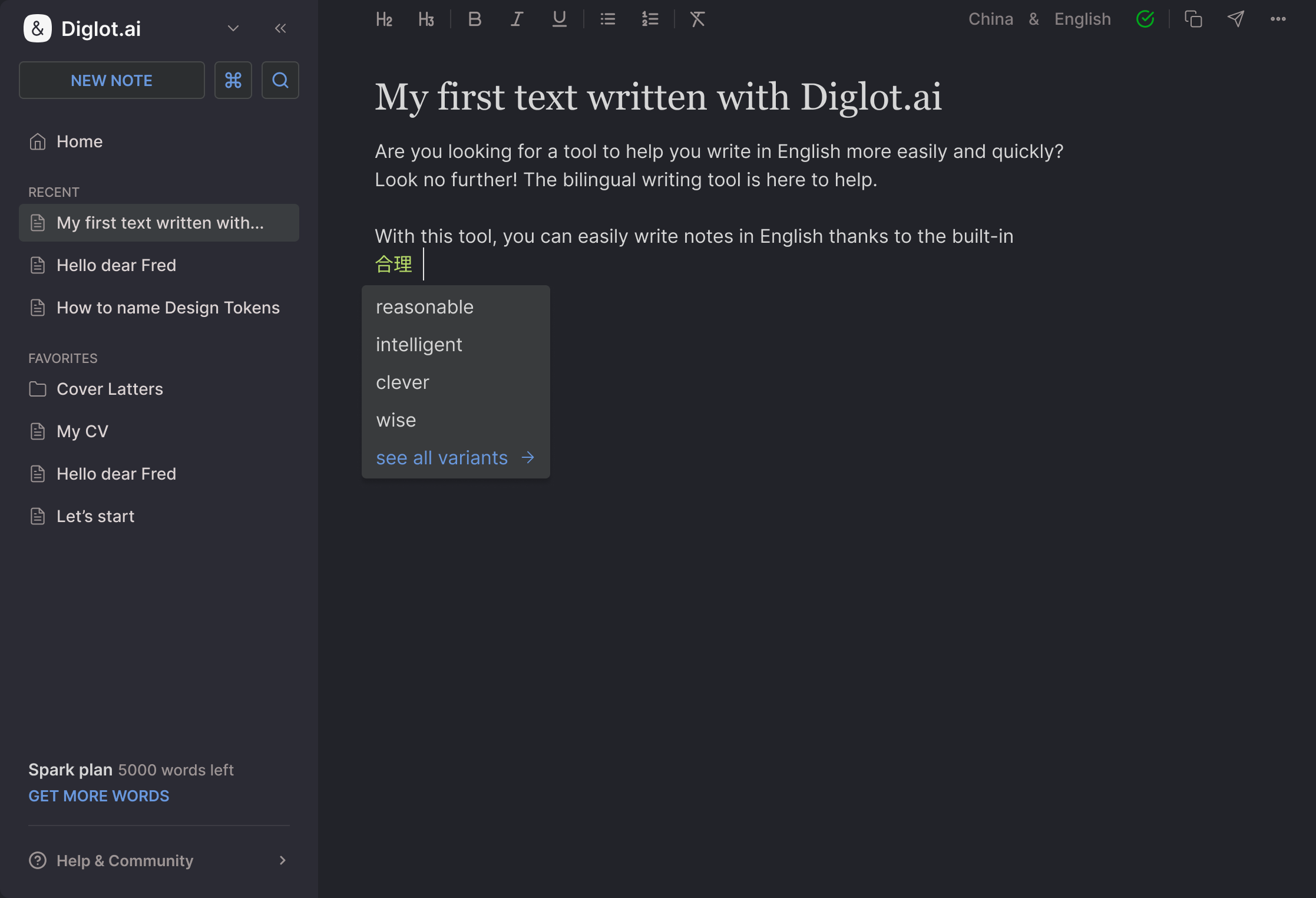
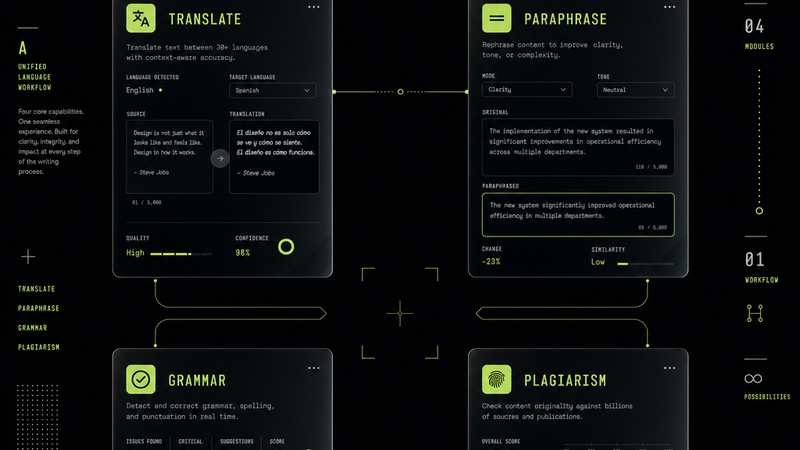
Diglot goes further than sentence rewriting by treating the whole bilingual writing flow as one workspace. AI drafting, translation, grammar correction, paraphrasing, and originality verification all share the same document context. For non-native writers the bottleneck is rarely just polishing — it is drafting, translating, rewriting, and correcting at the same time.
This matters for non-native English speakers because the bottleneck is rarely just polishing. It is often drafting, translating, rewriting, and correcting all at once. Diglot supports that entire sequence instead of only the rewrite step.
Rewriting and Paraphrasing
For sentence-level refinement, Wordtune is strong: it offers quick options and tightens wording fast. Diglot becomes more useful when rewriting needs to stay attached to the rest of the writing workflow. You can translate a phrase, correct grammar, paraphrase it, and continue drafting inside the same document instead of moving text between tabs.
If your only need is sentence-level refinement, Wordtune is strong. It gives quick options, helps simplify wording, and often improves readability fast.
Diglot is more useful when rewriting has to stay connected to the rest of the writing workflow. You can translate a phrase, correct grammar, paraphrase it, and continue drafting without leaving the same interface.
Verdict
Wordtune is excellent for rewrite-first workflows. Diglot is stronger for full drafting-and-rewrite workflows.
Grammar and ESL Support
On grammar and ESL support, Wordtune optimises for clarity rather than depth of correction. It improves how text reads but is not built around the patterns non-native speakers repeat. Diglot combines rewriting with L1-aware grammar review across six first languages, which is what you usually need when a sentence is both unstable and stylistically awkward.
Wordtune focuses more on clarity than on grammar depth. It improves how text reads, but it is not built around the common grammar patterns that non-native speakers struggle with every day.
Diglot combines rewriting with grammar and spelling support, which is often more useful for ESL writers. If the sentence is grammatically unstable and stylistically awkward, you need both layers together.
Verdict
Diglot is better when your writing needs both correction and clearer phrasing.
Bilingual Workflow
Wordtune assumes your writing already starts in English, which works fine for many users but not for bilingual writers. Diglot is built for the opposite case: you may think in another language first, translate the idea, then refine it. Translation lives inside the editor so the bilingual draft-to-final loop never leaves the same workspace.
Wordtune assumes your writing starts in English. That is a fine assumption for many users, but it does not match the real workflow of millions of bilingual writers.
Diglot is built for the opposite case: you may think in another language first, translate ideas into English, and then refine them. This is why Diglot supports translation and bilingual document-to-draft workflows directly in the editor.
Verdict
For multilingual writing and ESL use cases, Diglot offers a more realistic workflow than Wordtune.
Which One Should You Choose?
Choose Wordtune if you already write comfortably in English and mainly want cleaner, tighter phrasing for content you have drafted yourself. Choose Diglot if you need help across the full path from idea to polished English, especially if you translate from a first language, draft bilingually, or want grammar and rewriting connected in one workspace.
Choose Wordtune if: you already write comfortably in English and mainly want cleaner, tighter phrasing.
Choose Diglot if: you need help across the whole path from idea to polished English, especially if you translate, draft bilingually, or want grammar and rewriting in one place.
For non-native English speakers, the distinction is important. Wordtune helps refine English you already have. Diglot helps you produce stronger English from the start.
Try Diglot for free if you want one writing workflow that covers drafting, rewriting, translation, and grammar support together.
Share