

In this article
Paraphrasing is one of the most important academic writing skills, and one of the hardest for non-native English speakers to master. The challenge is not just finding different words — it is expressing the same idea in a genuinely different way while maintaining accuracy.
Most ESL writers learn paraphrasing by example, and the examples they see are often too simple. Swapping a few words with synonyms is not paraphrasing. It is patchwriting, and it can get you in serious academic trouble.
What Good Paraphrasing Actually Looks Like
Good paraphrasing changes three things at once: sentence structure, vocabulary, and sometimes the order of information presented. The meaning stays identical to the source, but the expression is genuinely original — not a synonym swap. Plagiarism detection tools increasingly flag structural similarity, not only matching words, so structure has to move for a paraphrase to hold.
Consider this original passage: "Students who regularly engage with feedback from grammar checkers develop stronger writing skills over time."
A patchwrite would be: "Students who consistently interact with corrections from grammar tools build better writing abilities over time." Same structure, same word order, just synonyms swapped.
A genuine paraphrase would be: "Regular exposure to grammar correction feedback helps students gradually improve their writing." Different structure, different emphasis, same core meaning.
The distinction matters because plagiarism detection tools are increasingly sophisticated at catching structural similarity, not just word matches.
Why Paraphrasing Is Harder for ESL Writers
Paraphrasing is harder for non-native English writers because the inventory of alternative sentence structures is smaller. Native speakers know five ways to say the same thing and pick one instinctively. ESL writers often reach for the most obvious change — synonym swapping — because real restructuring needs grammatical confidence that takes years of immersion to build.
ESL writers often have a smaller inventory of English expressions. When asked to paraphrase, they reach for the most obvious change — swapping words — because restructuring the sentence requires grammatical confidence they may not have.
This is why paraphrasing tools are particularly useful for non-native speakers. A paraphrasing tool can suggest structural alternatives that the writer might not think of independently, expanding their repertoire of English sentence patterns.
The Paraphrase-Then-Check Workflow
The safest paraphrasing workflow combines rewriting with verification at every step. Understand the source until you can explain the idea without looking at the original. Close it and write your own version. Compare against the source for matching phrases or structures. Run a plagiarism check on the result. Add a citation to the original idea.
Step 1: Understand the source. Read until you can explain the idea without looking at the text. Understanding before rewriting is the foundation of genuine paraphrasing.
Step 2: Write your version. Close the source and write the idea in your own words. If you are stuck, start with the conclusion of the original passage and work backwards — this naturally produces a different structure.
Step 3: Check for closeness. Compare your version to the original. Look for matching phrases of three or more words, identical sentence structures, and similar word order. Rewrite anything that is too close.
Step 4: Verify with a plagiarism checker. Run a plagiarism check on the paraphrased section. If fragments are flagged, they need further rewriting. A clean result confirms your paraphrase is genuinely original.
Step 5: Add the citation. Even a perfect paraphrase needs attribution. The idea came from someone else — credit them.
Paraphrasing in Diglot
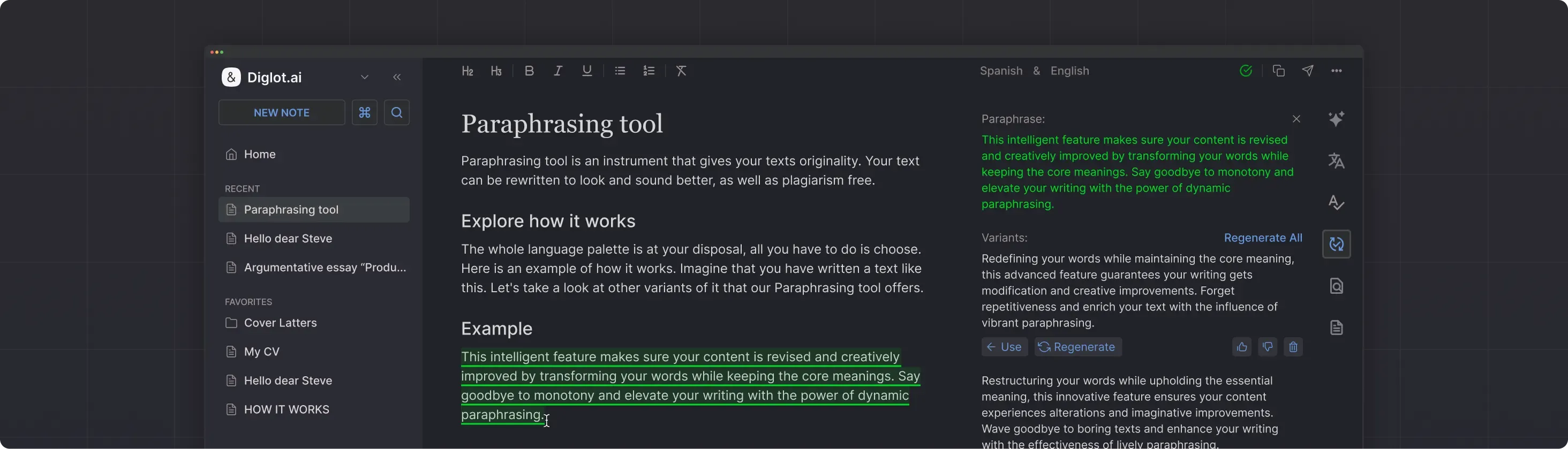
Diglot's paraphrasing tool is connected to grammar review and originality verification inside one workspace. After a rewrite, you can immediately catch any new grammar errors the paraphrase introduced and confirm the result is genuinely different from the source. The same document context flows through every step, so each tool's suggestions stay coherent.
For academic writing, this connected workflow is safer than using a standalone paraphraser. You see the grammar impact and originality result of every rewrite immediately, which helps you learn to paraphrase more effectively over time.
Try Diglot for free — paraphrase, check grammar, and verify originality in one workspace.