Founder of Diglot.ai
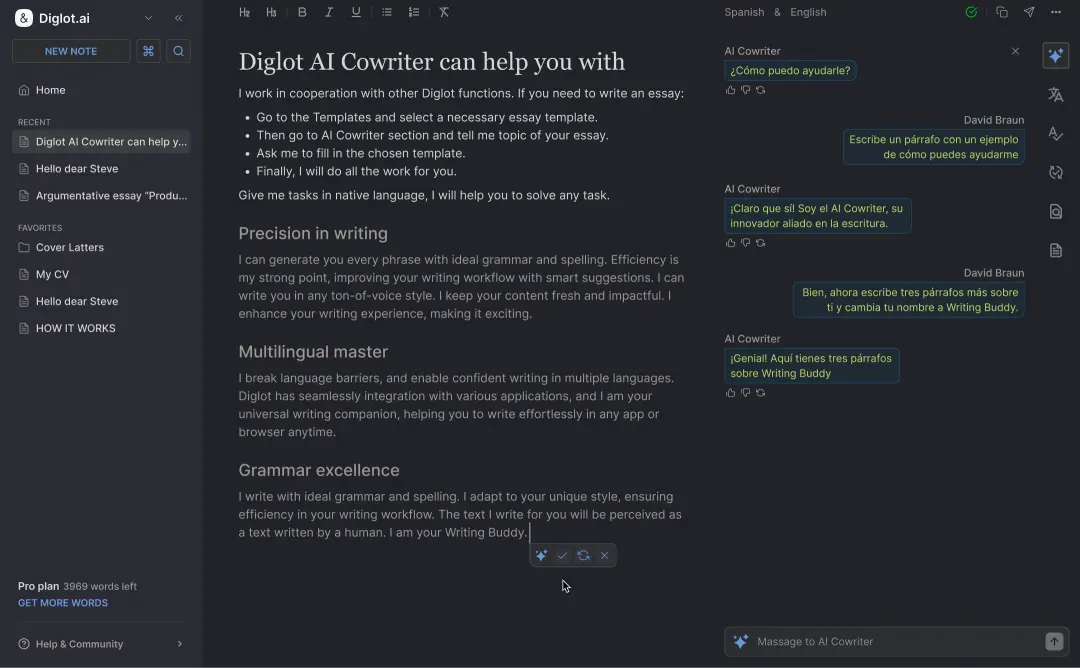
Alex Zhovnir is the founder of Diglot.ai, a bilingual writing workspace built specifically for ESL and non-native English speakers. The platform combines L1-aware grammar checking, three-tier translation, paraphrasing, and originality verification inside a single editor — calibrated for the patterns Korean, Chinese, Japanese, Spanish, Russian, and Arabic writers face when publishing in English.
Why L1-Aware Writing Tools Matter
Most English writing tools (Grammarly, QuillBot, ChatGPT) were trained on native-English baselines and treat ESL writers as if they were sloppy natives. They miss the predictable patterns — Korean article omission, Chinese tense flattening, Spanish false cognates, Russian long subordinate chains — that signal "non-native" to a reviewer in seconds. Diglot is built around contrastive linguistics so each correction explains the L1 reason, not just a generic English rule.
AI Translation in a Bilingual Workspace
Generic translators (DeepL, Google Translate, ChatGPT) return one black-box rendering and expect the writer to figure out whether it fits the reader. Diglot returns three side-by-side renderings — literal, idiomatic, formal — so writers pick what matches their audience. The L1 source stays anchored on screen the entire time, and translation memory persists approved phrasings across every document.
Grammar Built for Non-Native English
The Diglot grammar checker recognizes Korean -고/-며 connector chains that produce English comma splices, Japanese topic markers that surface as awkward English subjects, Chinese aspect markers (le, guo, zhe) that map to wrong English tenses, Arabic definite-article overuse, Spanish subjunctive overcorrection. Each pattern is grounded in published ESL research, not generic English-grammar heuristics.
Paraphrasing and Originality Together
For ESL writers, paraphrasing and originality verification are linked. Translation-derived overlap is the dominant ESL plagiarism failure mode — students paraphrase source material across languages and end up with structural similarity even when wording changes. Diglot ships paraphrase + originality + AI-text detection in the same workflow, with the L1-aware paraphraser handling flagged passages while preserving citations.
Templates for the Formats ESL Writers Actually Use
Templates encode the structural and register conventions native speakers absorb implicitly but ESL writers learn deliberately. US business email defaults 50-150 words; Japanese keigo-influenced phrasing reads as servile in American business contexts; "kindly" carries Indian-English connotations US readers misread. Diglot templates encode these conventions so the writer starts with the right register, not just the right structure.
Where Diglot Is Going Next
The next two years are about expanding L1 coverage beyond the initial six (Korean, Chinese, Japanese, Spanish, Russian, Arabic) to twenty deep-coverage languages, shipping the Authorship Certificate for cryptographically signed writing-process records, and building cross-tool workflows for the four highest-stakes ESL writing contexts: academic publishing, business communication, content marketing, and English-language student work.