AI Paraphrasing Tool for ESL & Non-Native Writers
Diglot paraphrases L1-flavored English into natural prose without losing your meaning. Tuned for Korean topic-comment structures, Spanish false cognates, Chinese aspect markers, and Russian long subordinate chains — patterns QuillBot and Wordtune treat as generic English. Works inside the same editor as grammar checking and translation, no copy-pasting between tabs.
*No credit card required
Why ESL writers need more than a generic synonym swap
QuillBot rewrites sentences as if everyone writes from the same baseline English. ESL writers do not — Korean writers chain -고/-며 connectors into comma splices, Spanish writers paste false cognates like "actually" for "actualmente", Chinese writers flatten tense. Diglot recognizes these L1 patterns and rewrites them into native English while preserving your meaning, citations, and technical vocabulary.
Apologetic fluff & boilerplate
Defaults to verbose, deferential openings ("I hope this email finds you well", "I am writing to kindly inquire"). Reads as subordinate and wastes senior stakeholders' time.
Native-speaker syntax bias
Catches basic comma splices and spelling typos, but completely misses L1 cultural transfers, Japanese Keigo servility, Spanish false cognates, or tone mismatch.
Isolated sentence translation
Translates sentences accurately in isolation, but lacks document-level tone calibration, context memory, and consistent business terminology across releases.
Calibrated executive workspace
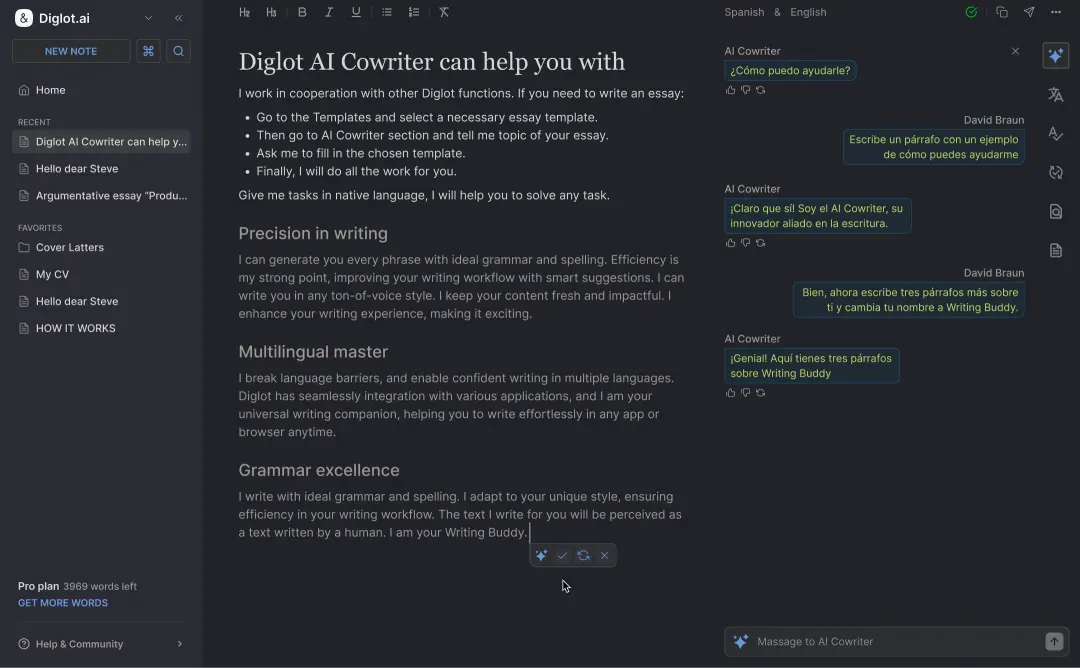
In-place three-tier translation, register calibration, L1-transfer neutralization, and persistent translation memory inside a single focused editor.
Built around real bilingual business workflows
Everything non-native professionals need to write, translate, and verify high-stakes English in one place.
Register & Formality Calibrator
Calibrate writing to target US vs UK executive norms. Neutralize Keigo-style subservience, legalese filler, and culturally awkward greetings before sending to leadership.
- Senior Executive vs Peer tone tuning
- Eliminates "kindly", "as per", and "revert"
- Action-oriented CTA phrasing
Three-Tier Inline Translation
Translate difficult words or full sentences inline without leaving the editor. View Literal, Idiomatic, and Executive Business translations side-by-side.
- In-place paragraph translation
- Literal vs Idiomatic vs Executive tiers
- Preserves source context and document formatting
Persistent Translation Memory
Brand names, product terms, contractual clauses, and company acronyms stay 100% consistent across every email, proposal, and report you write.
- Locked vocabulary across documents
- Shared team glossaries
- Zero terminology drift between releases
AI Cowriter for Business Formats
Transform rough bullet points, meeting notes, or native-language thoughts into polished client emails, status memos, and executive decks in seconds.
- Instant expansion of rough bullet notes
- Calibrated for non-native thinking habits
One connected workflow from raw draft to final deliverable
Move from bilingual rough ideas to polished English in one calm flow instead of stitching together separate tools.
Highlight the awkward sentence
Select the phrase that sounds translated, repetitive, or too stiff for the audience you are writing for.
Choose the rewrite mode
Pick a style such as formal, academic, concise, or humanize depending on the task in front of you.
Compare several versions
Review multiple rewrites side by side, regenerate a single option, and keep the variant that best preserves your meaning.
Keep the good version in the draft
Replace the selection and continue writing immediately instead of exporting text to a separate paraphrasing tool.
Built for high-stakes business communicators
Diglot works best when English is your delivery language, but not always your thinking language.
International students
Move from rough documents to cleaner English submissions with structure, paraphrasing, and grammar review in one place.
Bilingual creators
Turn ideas that start in your native language into natural English copy without bouncing between translation and rewrite tools.
Multilingual professionals
Write faster for work without sounding translated. Diglot helps you refine tone, clarity, and confidence before you hit send.
Confidentiality & editorial standards
Your business drafts, customer proposals, and internal communications belong strictly to your team.
Zero model training on your data
Your drafts, emails, and translations are never used to train public AI models. Data is encrypted in transit and at rest with strict multi-tenant isolation.
Calibrated specifically for non-native professionals
Examples, register models, and workflow conventions are shaped for managers, engineers, and consultants who need confident English output without losing meaning.
Reviewed by Diglot Editorial Team
Page updated May 22, 2026. We regularly update guidelines as international business English standards and corporate communication norms evolve.
Frequently asked questions
Everything you need to know before getting started.
What does the paraphrasing tool do?
Diglot rewrites sentences and paragraphs to improve clarity and fluency while preserving your meaning, citations, and technical terminology. For ESL writers it specifically targets L1-transfer patterns — Korean topic-comment word order, Spanish false cognates, Chinese aspect-marker drops, Russian long subordinate chains — that generic paraphrasers treat as random awkwardness rather than predictable patterns.
How is Diglot different from QuillBot or Wordtune?
QuillBot and Wordtune rewrite everyone the same way regardless of native language. Diglot is L1-aware — Korean writers get topic-comment alternatives; Spanish writers get false-cognate scrubbing; Chinese writers get aspect-marker mapping. Each rewrite is grounded in contrastive linguistics, not generic synonym substitution. Plus paraphrase, grammar, and translation share one editor instead of three.
Can I use it for academic writing?
Yes — academic paraphrasing is a primary use case. Diglot preserves citation eligibility (paraphrase + citation hint mode prompts you to add inline citations), keeps technical vocabulary locked, and offers register modes (formal, academic, conversational). Especially useful for thesis chapters and grant abstracts where reviewer-acceptable phrasing matters as much as semantic accuracy.
Will it help me sound more natural in English?
Yes — that is the core promise. ESL writers often produce "translated English" that is grammatically correct but feels slightly off to native readers. Diglot identifies the L1-transfer patterns producing that off-ness (preposition errors from German, subjunctive overuse from Spanish, copula drops from Russian, modifier-noun chains from Japanese) and rewrites them into natural English without flattening your authorial voice.
Does it work together with grammar checking and translation?
Yes — paraphrasing, grammar checking, and translation all share the same document context inside Diglot. Translate a paragraph from your L1, run a grammar pass, and paraphrase awkward sentences before publishing — without copy-pasting between three browser tabs. Per-writer translation memory keeps technical terms consistent across the whole workflow.
Is the paraphrasing tool free?
Yes — the free plan includes core L1-aware paraphrasing for the top six L1s (Korean, Chinese, Japanese, Arabic, Spanish, Russian). Spark ($19/month) and Pro ($34/month) unlock higher monthly word quotas, larger document sizes, premium model tiers for more nuanced rewrites, and access to the AI-text humanization mode for cleaning ChatGPT-generated drafts.
Explore all Diglot workflows
Discover specialized tools built to support your English writing from rough notes to polished delivery.
Draft, refine, and rewrite English with AI support built for non-native speakers.
Translate, compare, and edit multilingual text in one writing workflow.
Catch grammar, spelling, and punctuation issues while you write in English.
Rewrite sentences, improve fluency, and keep your original meaning clear.
A signed, verifiable record of how your text was written inside Diglot — writing-process evidence you can share.
Paraphrasing Tool for speakers of:
Diglot's checker models L1-to-English transfer patterns for each language family. Pick yours for the patterns we specifically address.

Explore how Diglot's AI paraphrasing tool helps rewrite sentences, improve fluency, and keep content original.

See how Diglot combines paraphrasing, grammar checks, plagiarism detection, and translation to improve English writing.
Three different answers to one question: detectors do not care that it was Grammarly, some university policies name it explicitly, and students have been penalised. What matters is the function you used — spellcheck and rewrite are not the same act. Sourced, dated, and checked against the vendors own documentation.
Write in your language,
publish in English
Move from rough bilingual drafts to clearer English in one connected writing workflow.
AI paraphrasing for ESL writers is fundamentally different from generic English-to-English rewriting. The hard cases are not random awkward sentences — they are predictable L1-transfer patterns. A Korean writer chains -고/-며 connectors into English comma splices because Korean conjunctive endings have no direct equivalent. A Spanish writer pastes "actually" for "actualmente" without realizing the false cognate flips the meaning from "currently" to "in fact". A Chinese writer flattens English tense because Mandarin does not inflect verbs.
A Japanese writer over-formalizes business English because keigo register cues do not map cleanly to US business neutral. Generic paraphrasers — QuillBot, Wordtune, Grammarly's paraphrase mode — treat each of these as random awkwardness and rewrite them with one-size-fits-all synonym substitution, often making the result less natural rather than more. Diglot is the only paraphrasing tool built around L1-transfer pattern recognition. Each rewrite is grounded in contrastive linguistics drawn from published ESL research and live error corpora.
Korean writers see two rewrite paths — one that preserves natural Korean information order for readers familiar with Asian academic style, one that fully Anglicizes structure for Western reviewers. Spanish writers get explicit false-cognate scrubbing. Chinese writers get aspect-marker mapping (le/guo/zhe routed to past/perfect/progressive). All inside the same editor as the grammar checker and translator — so the bilingual workflow stops requiring three browser tabs and three copy-pastes. Free for the top six L1s, with higher quotas on Spark and Pro plans.
